
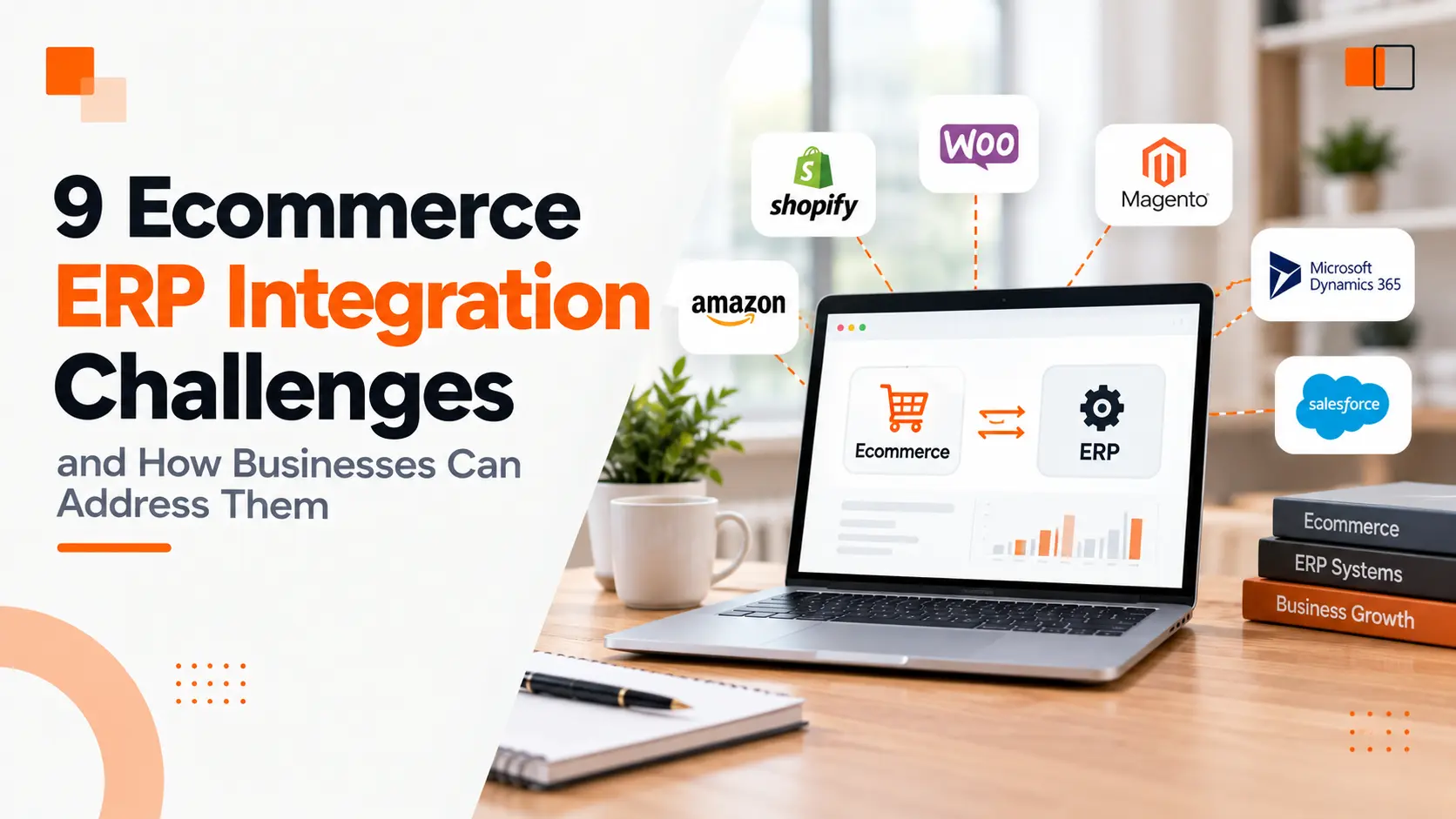
When an ecommerce business grows, managing orders, inventory, customer information, and financial records across separate systems becomes increasingly complicated. An ERP integration can connect these operations, but the process introduces its own technical and operational challenges.

Incorrect data mapping, delayed inventory updates, incompatible APIs, and poorly managed workflows can disrupt business operations if they are not addressed early. Understanding these issues helps businesses plan a more reliable integration and avoid unnecessary rework.

Here are nine common ecommerce ERP integration challenges, why they occur, and the practical steps businesses can take to address them.

What Is Ecommerce ERP Integration?

Ecommerce ERP integration connects an online store with an Enterprise Resource Planning (ERP) system so relevant business information can move between platforms.

An ecommerce platform typically manages online shopping and checkout, while an ERP may handle inventory, procurement, accounting, product records, and other operational processes. An integration allows these systems to exchange information instead of relying entirely on manual data entry.

Depending on the business requirements, the integration may synchronize:

  • Product details, SKUs, and pricing
  • Inventory levels and warehouse availability
  • Customer records and sales orders
  • Shipping, fulfilment, and order status
  • Returns, refunds, and financial records

Businesses can use native connectors, middleware, integration platforms, or custom APIs to connect their systems. The right approach depends on the software involved, workflow complexity, transaction volume, and available technical resources.

1. Inconsistent Data Across Ecommerce and ERP Systems

One of the most common ecommerce ERP integration challenges is ensuring that both systems interpret information consistently.

An online store may identify a product using a SKU and variant ID, while the ERP uses a different internal product code. Customer names, address formats, tax fields, and pricing structures may also follow different rules.

When the integration transfers information without appropriate mapping, records can become duplicated, incomplete, or incorrectly associated.

How businesses can address it

Start by reviewing the quality and structure of the data in both systems. Identify duplicate records, inconsistent product identifiers, missing fields, and differences in formatting before connecting the platforms.

Businesses should also:

  • Define which system owns each type of data.
  • Create a field-mapping document before development.
  • Standardize SKUs, product identifiers, and relevant data formats.
  • Establish validation rules for incoming and outgoing records.
  • Test data migration and synchronization with representative records.

Example: If an online store identifies a product as TSHIRT-BLK-M but the ERP uses a different code, the integration needs a reliable mapping between the two identifiers. Otherwise, stock updates may affect the wrong product or fail entirely.

Resolving data inconsistencies early makes the integration easier to test, maintain, and expand.

2. Inventory Synchronization and Stock Accuracy Issues

Inventory discrepancies can create immediate problems for ecommerce businesses. A product may appear available online even though the warehouse has sold the remaining units or reserved them for another order.

These issues can occur when stock updates are delayed, multiple systems modify inventory independently, or the integration does not account for reservations, returns, and warehouse-specific availability.

How businesses can address it

Define how inventory should move between the ecommerce platform and the ERP. In many businesses, the ERP or inventory management system acts as the primary source for available stock, although the correct arrangement depends on the existing architecture.

Useful measures include:

  • Defining inventory ownership and synchronization frequency.
  • Accounting for reserved, damaged, and unavailable stock.
  • Establishing rules for multiple warehouses and sales channels.
  • Monitoring delayed or failed inventory updates.
  • Testing simultaneous orders and stock adjustments.
  • Using safety stock rules where appropriate.

Not every inventory workflow requires instant synchronization. However, businesses with high order volumes or limited stock may need event-driven or near-real-time updates to reduce overselling risks.

The objective is to ensure that customers see a reliable representation of the inventory available for purchase.

3. Complicated Order Processing and Fulfilment Workflows

An ecommerce order may pass through several systems before it reaches the customer. The store receives the order, the ERP records it, the warehouse prepares the items, and a shipping provider supplies tracking information.

If these systems use different order statuses or processing rules, the integration can lose important updates. Duplicate orders, missing fulfilment information, and incorrect cancellation handling are common examples.

How businesses can address it

Map the complete order lifecycle before building the integration. Document what should happen when an order is created, paid, partially fulfilled, cancelled, returned, or refunded.

The implementation should include:

  • Clear mappings between order statuses.
  • Duplicate-prevention mechanisms for repeated events.
  • Retry procedures for failed order transfers.
  • Rules for partial shipments and split orders.
  • Synchronization of relevant tracking and fulfilment updates.
  • Testing for cancellations, refunds, and exceptional scenarios.

Example: A customer cancels an order shortly after checkout. If the cancellation reaches the ecommerce platform but not the ERP, the warehouse may still prepare the package.

A properly defined workflow ensures that both systems handle the cancellation consistently and that the appropriate inventory adjustments occur.

4. API Limitations and System Compatibility

APIs allow ecommerce platforms and ERP systems to exchange information, but their capabilities and restrictions differ.

An ERP may have limited API access, strict request limits, older authentication methods, or data structures that do not match the ecommerce platform. Some systems may also require specialized connectors or intermediate software to communicate effectively.

How businesses can address it

Evaluate the technical capabilities of both systems before choosing an integration architecture.

Businesses should:

  • Review available API documentation and supported operations.
  • Check authentication requirements and request limits.
  • Confirm which records can be created, updated, or retrieved.
  • Implement appropriate retry and rate-limit handling.
  • Plan for API version changes and deprecations.
  • Use supported connectors or middleware where suitable.
  • Avoid unsupported direct changes to application databases.

Custom API integration may be appropriate when a business needs specialized workflows or when existing connectors cannot meet its requirements.

However, custom development should be based on a clear technical assessment. A native connector may be more practical when it already supports the required processes.

5. Legacy ERP Systems and Existing Technical Debt

Some businesses operate ERP systems that have been customized over many years. These systems may rely on older interfaces, undocumented business rules, or workflows that were designed before modern ecommerce platforms became central to operations.

Connecting a legacy ERP to a newer online store can therefore require more than simply transferring data between two applications.

How businesses can address it

Begin with a technical audit of the ERP, existing customizations, available interfaces, and business processes.

The integration team should determine which functions can be accessed through supported APIs, connectors, file transfers, or other approved mechanisms.

A practical approach includes:

  • Documenting existing workflows and dependencies.
  • Identifying unsupported or outdated components.
  • Reviewing available connectors and integration interfaces.
  • Separating legacy-specific logic where feasible.
  • Implementing changes in manageable stages.
  • Planning maintenance before the integration goes live.

Replacing the entire ERP is not always necessary. In many cases, a carefully designed integration can connect existing systems while allowing the business to plan future modernization separately.

The key is to understand the limitations before committing to a solution.

6. Security, Access Control, and Compliance Risks

An ERP integration may transfer sensitive customer information, order records, commercial data, and financial information. Connecting systems without appropriate security controls can increase the risk of unauthorized access or data exposure.

Security concerns can arise from overly broad API permissions, exposed credentials, insufficient monitoring, or insecure data transmission.

How businesses can address it

Security should be considered during the architecture and planning stages, not added only after development.

Recommended practices include:

  • Using secure authentication and appropriately managed credentials.
  • Applying least-privilege access to integration accounts.
  • Encrypting data in transit.
  • Protecting credentials and secrets from exposure.
  • Maintaining appropriate audit logs.
  • Monitoring unusual access and integration activity.
  • Reviewing data retention and applicable privacy requirements.

Businesses should also assess the security practices of third-party integration providers and middleware vendors.

Compliance requirements depend on the business’s location, the data being processed, and the applicable regulations. A technical integration alone does not guarantee compliance, so organizations should involve the appropriate security and compliance stakeholders.

7. Poor Error Handling and Limited Integration Visibility

An integration can appear to be working while individual records quietly fail to synchronize. For example, an order might reach the ERP successfully, while its shipping update never reaches the ecommerce store.

Without monitoring, these failures may remain unnoticed until customers complain or teams discover discrepancies during reconciliation.

How businesses can address it

Build monitoring and recovery processes into the integration from the beginning.

Important measures include:

  • Centralized logs for integration activity.
  • Alerts for failed or delayed data transfers.
  • Retry policies with appropriate limits.
  • Idempotent processing to prevent duplicate actions.
  • Exception queues for records that need investigation.
  • Reconciliation reports comparing records across systems.
  • Documented recovery procedures for failed transactions.

Idempotent processing means that repeating the same operation does not unintentionally create the same business action multiple times. It is particularly useful when an API request times out and the integration cannot immediately determine whether the original request succeeded.

Monitoring should show not only whether the connection is active, but also whether critical business records are moving correctly.

8. Performance Problems as the Business Scales

An integration that works well for a small store may struggle when order volumes increase, the product catalogue expands, or seasonal traffic creates sudden demand.

Large data transfers, inefficient API requests, repeated full-catalogue synchronization, and poorly managed background processes can slow down updates or exceed platform limits.

How businesses can address it

Design the integration around realistic business volumes and expected growth.

Consider the following practices:

  • Conduct load and performance testing.
  • Use incremental updates when full synchronization is unnecessary.
  • Apply batch processing to suitable large data transfers.
  • Use queues for workflows that benefit from asynchronous processing.
  • Prioritize time-sensitive order and inventory events.
  • Monitor API usage, processing times, and failed requests.
  • Plan capacity for peak trading periods.

The architecture should reflect the importance of each workflow. Inventory availability and new orders may need faster processing than some financial reporting updates.

Scaling should also account for future warehouses, sales channels, product variants, and integrations with other operational systems.

9. Inadequate Testing, Unclear Ownership, and Maintenance

ERP integration does not end when the connection is deployed. New software versions, changing business requirements, updated APIs, and evolving workflows can introduce issues over time.

Problems become more difficult to resolve when nobody clearly owns the integration or when business teams and technical teams have different expectations about how the system should behave.

How businesses can address it

Establish clear responsibilities before launch and maintain them after deployment.

A reliable process should include:

  • Documented integration requirements and data mappings.
  • Defined ownership for each system and data type.
  • End-to-end testing using realistic business scenarios.
  • User acceptance testing with relevant operational teams.
  • Procedures for managing software and configuration changes.
  • Monitoring responsibilities and escalation contacts.
  • Scheduled reviews of performance, security, and reliability.

Testing should cover normal transactions as well as unusual scenarios, including failed payments, duplicate events, cancelled orders, partial fulfilment, and unavailable inventory.

A named owner should also be responsible for reviewing alerts, coordinating fixes, and ensuring that the integration remains aligned with business operations.

Treating maintenance as an ongoing responsibility helps prevent a successful launch from becoming an unreliable system later.

Ecommerce ERP Integration Checklist Before You Start

Before selecting a connector or beginning custom development, review the following checklist.

  • Business objectives: Define what the integration should improve, such as order processing, stock accuracy, or reporting.
  • System compatibility: Confirm that the ecommerce platform and ERP can exchange the required data.
  • Data mapping: Document field mappings, product identifiers, and data ownership.
  • Workflow requirements: Define order, inventory, fulfilment, cancellation, and refund processes.
  • Integration method: Evaluate native connectors, middleware, and custom APIs.
  • Security: Review authentication, permissions, data protection, and access logging.
  • Error handling: Plan retries, alerts, reconciliation, and recovery procedures.
  • Testing: Prepare test cases for normal operations and failure scenarios.
  • Scalability: Estimate transaction volumes and future integration requirements.
  • Ongoing support: Assign responsibility for monitoring, maintenance, and updates.

Completing this assessment helps businesses identify potential obstacles before they affect live operations.

Choosing the Right Ecommerce ERP Integration Approach

The right integration method depends on the systems involved, the complexity of the business workflows, and the resources available for implementation and maintenance.

Integration approach Best suited for Key consideration
Native connector Standard workflows supported by an existing connector Confirm feature coverage and configuration limits
Middleware or iPaaS Businesses connecting several applications Review subscription costs, data flows, and platform limits
Custom API integration Specialized workflows and requirements Account for development, monitoring, and maintenance
Hybrid integration Businesses combining standard and custom processes Define ownership across all integration components

A native connector can reduce implementation effort when it supports the required workflows. Middleware can help coordinate data across multiple applications. Custom APIs offer greater control over specialized processes but require appropriate development and ongoing technical support.

A hybrid approach may be suitable when some workflows are covered by existing connectors while others need custom logic.

Before deciding, compare total cost of ownership, technical compatibility, data volume, maintenance needs, and the business impact of integration failures.

How 9eCommerce Can Help With Ecommerce Integration

Connecting an ecommerce platform with an ERP requires an understanding of both the technology and the business processes behind it. Product data, inventory rules, order status, and fulfilment workflows must work together as part of a consistent system.

9eCommerce offers ecommerce development and API integration services that can support businesses evaluating their integration requirements. Its API services include integration, custom API development, testing, and maintenance, while its ecommerce capabilities cover integrations with third-party systems and business applications.

Depending on the project’s requirements, businesses may need assistance with:

  • Assessing existing ecommerce architecture and integration needs.
  • Reviewing API and connector options.
  • Mapping data flows and business workflows.
  • Planning custom API development where appropriate.
  • Testing synchronization and critical transaction flows.
  • Improving integration monitoring and ongoing maintainability.

The appropriate solution depends on the ERP product, ecommerce platform, available interfaces, and required business processes. These should be assessed before a specific integration approach is recommended.

If your business is planning a new ecommerce ERP integration or needs to improve an existing connection, 9eCommerce can help you discuss your requirements and evaluate suitable integration options.

Conclusion

Ecommerce ERP integration can help businesses connect online sales with inventory, order management, fulfilment, and financial operations. However, inconsistent data, inventory discrepancies, API limitations, security risks, and inadequate monitoring can undermine the results if they are not addressed properly.

The most reliable approach begins with clear business requirements, accurate data mapping, suitable integration architecture, and realistic end-to-end testing. Businesses should also establish ownership, monitoring, and maintenance procedures before the system goes live.

There is no single integration method that suits every organization. By assessing existing systems and operational needs carefully, businesses can choose an approach that supports their current workflows while accommodating future growth.

For businesses evaluating their integration requirements, 9eCommerce can help explore suitable ecommerce development and API integration options.
Gujarat’s manufacturers, wholesalers, and distributors need ecommerce stores that support complex product catalogues, bulk ordering, customer-specific pricing, and business integrations. Choosing the right BigCommerce development partner can help streamline B2B purchasing and improve the online buying experience.

What B2B Businesses Need from a BigCommerce Development Partner

B2B ecommerce stores have different requirements from standard online shops. Before choosing a development company, consider these essential capabilities:

  • Product catalogue management: Organize large inventories, product specifications, variants, and SKUs.
  • B2B purchasing features: Support bulk orders, quote requests, customer accounts, and repeat purchases.
  • Custom store design: Make product discovery and ordering simple across desktop and mobile devices.
  • Business integrations: Connect the store with ERP, CRM, inventory, accounting, and shipping systems.
  • Search and filtering: Help customers find products by specifications, categories, brands, and other attributes.
  • Scalability and support: Ensure the store can accommodate business growth, new products, and changing workflows.

7 BigCommerce Development Companies in Gujarat

1. 9eCommerce

9eCommerce provides BigCommerce development services, including custom theme design, store migration, application development, API integrations, and ongoing maintenance. Its services are relevant to businesses that need a customized ecommerce storefront connected with their existing business systems.

For B2B organizations exploring BigCommerce development services in India, 9eCommerce is worth considering for projects involving product catalogue management, custom functionality, and third-party integrations. Businesses should discuss their requirements for bulk purchasing, product filtering, and customer-specific ordering workflows.

Best suited for: B2B businesses seeking custom BigCommerce development, migration, and integration support.

What to verify: Ask for relevant B2B project examples and confirm how the proposed solution will support your catalogue and purchasing requirements.

2. DIT India

DIT India offers ecommerce design and development services, including store customization, migration, and technical support. Its broader ecommerce capabilities can be relevant to businesses planning a new online store or improving an existing digital commerce experience.

Companies looking to Hire BigCommerce Developers in India can evaluate DIT India for storefront improvements, product catalogue organization, navigation, and integration requirements. For manufacturers and distributors, the discussion should cover product data management, ordering workflows, and connections with existing operational systems.

Best suited for: Businesses requiring ecommerce development, customization, and ongoing technical assistance.

What to verify: Request examples of similar projects and confirm experience with B2B pricing, bulk ordering, and ERP integrations.

3. DIT Interactive

DIT Interactive offers BigCommerce-related services such as store setup, theme customization, UI/UX design, checkout customization, API integration, and application development. These capabilities can help businesses build a storefront around their products and purchasing processes.

Companies considering BigCommerce website development in India can evaluate DIT Interactive for custom product pages, improved navigation, and additional ecommerce functionality. B2B businesses should discuss requirements such as account-based purchasing, complex product catalogues, and integration with inventory or customer management systems.

Best suited for: Businesses looking for custom storefronts, theme development, and ecommerce functionality.

What to verify: Confirm its experience with complex B2B workflows and the integrations required for your business.

4. Bliss Web Solution

Bliss Web Solution is an Ahmedabad-based company listed in the BigCommerce partner directory. Its service areas include BigCommerce design, development, customization, migration, and support. Its listed industry coverage includes B2B and wholesale or manufacturing businesses.

For Gujarat-based manufacturers and distributors, the company may be worth evaluating for catalogue setup, storefront improvements, and migration projects. Businesses should explain their ordering process and determine whether the proposed implementation can support their product range, customer accounts, and operational requirements.

Best suited for: Wholesale and manufacturing businesses seeking BigCommerce development and customization.

What to verify: Ask about comparable B2B projects, catalogue complexity, ERP integrations, and customer-specific pricing.

5. Capacity Web Solutions

Capacity Web Solutions is an Ahmedabad-based BigCommerce partner with documented ecommerce development capabilities. Its partner profile highlights bulk-ordering functionality that allows customers to select quantities across product variants and add multiple items to their cart.

This functionality can be relevant to wholesalers and distributors whose customers regularly order several products or variants at once. Businesses can discuss how bulk ordering would work with their catalogue structure and whether additional features are needed for pricing rules, account management, and inventory synchronization.

Best suited for: Businesses that want to simplify bulk purchasing and variant-based ordering.

What to verify: Confirm the availability of required B2B features, customization options, and integration support.

6. Evrig

Evrig is an Ahmedabad-based company listed in the BigCommerce partner directory. Its documented service areas include ecommerce consulting, strategy, maintenance, and support. Its listed industry coverage includes automotive and B2B businesses.

The company may be worth evaluating for businesses planning an ecommerce project or looking for support with an existing store. Manufacturers and distributors can discuss platform requirements, catalogue organization, store maintenance, and the technical capabilities needed to support their online sales operations.

Best suited for: Businesses exploring ecommerce strategy, maintenance, and support.

What to verify: Ask for relevant BigCommerce development examples and confirm the availability of custom development and integration services.

7. Zestard Technologies

Zestard Technologies is an Ahmedabad-based ecommerce development company listed in the BigCommerce partner directory. Its service areas include store design, theme integration, theme customization, application development, and ecommerce optimization.

These capabilities may suit B2B businesses that want to improve their storefront or introduce additional functionality. Companies can discuss product-page layouts, catalogue navigation, application requirements, and connections with third-party systems to determine whether the proposed solution fits their operations.

Best suited for: Businesses seeking storefront customization, application development, and ecommerce improvements.

What to verify: Request comparable project examples and confirm support for complex catalogues, B2B purchasing, and business system integrations.

Comparison of BigCommerce Development Companies in Gujarat

Company Key Services Potential B2B Applications
9eCommerce Custom development, themes, migration, API integrations Customized storefronts and connected systems
DIT India Ecommerce development, customization, technical support Store development and operational integrations
DIT Interactive Store setup, theme customization, checkout and API development Tailored storefronts and custom functionality
Bliss Web Solution BigCommerce design, development, migration Wholesale and manufacturing ecommerce
Capacity Web Solutions Ecommerce development and bulk-ordering functionality Bulk and variant-based purchasing
Evrig Ecommerce consulting, strategy, maintenance Ecommerce planning and ongoing support
Zestard Technologies Store design, theme customization, applications Store improvements and custom functionality

How to Choose the Right BigCommerce Development Company

1. Define Your B2B Requirements

Identify the features your business needs, such as customer accounts, bulk ordering, quote requests, customer-specific pricing, and repeat purchases. A clear requirements document helps developers propose an appropriate solution.

2. Evaluate Catalogue Management

Manufacturers and distributors may manage thousands of SKUs, multiple product variants, technical specifications, and frequently changing inventory. Ask how the development team will structure product information and maintain accurate catalogue data.

3. Check Integration Capabilities

Determine whether your store needs to connect with ERP, CRM, inventory, accounting, or shipping systems. Discuss data synchronization, error handling, integration costs, and ongoing maintenance before finalizing the project scope.

4. Review Relevant Project Experience

Ask for examples of projects involving similar business models or technical requirements. General ecommerce experience does not necessarily demonstrate expertise in complex B2B pricing, bulk ordering, or large product catalogues.

5. Compare Scope, Cost, and Support

Review the proposal for development deliverables, timelines, testing, migration, documentation, and post-launch support. Compare providers based on the scope of work and long-term value rather than price alone.

6. Consider Location and Communication

If you prefer a Gujarat-based partner, confirm the company’s office location, team availability, meeting options, and support process. Ahmedabad-based providers may offer convenient local communication, while remote teams can also be suitable when project management and communication are clearly defined.

Conclusion

Choosing the right BigCommerce development partner involves evaluating technical capabilities, catalogue requirements, integration needs, and B2B purchasing workflows.

9eCommerce, DIT India, and DIT Interactive are options to evaluate alongside Gujarat-based providers such as Bliss Web Solution, Capacity Web Solutions, Evrig, and Zestard Technologies.

When comparing a BigCommerce development company in India, review relevant project experience, clarify the required features, and request a detailed proposal. The right partner should understand your business operations as well as your storefront requirements, helping you build an ecommerce experience that supports long-term growth.

Modern ecommerce brands need more than a basic online store. They need a scalable platform that can handle growing product catalogs, customer expectations, and future business expansion. This is why Magento continues to be a preferred choice for businesses looking for flexibility, customization, and enterprise-level ecommerce capabilities.

However, the success of a Magento store depends heavily on choosing the right development partner. A trusted Magento development company in India can help businesses create customized ecommerce experiences, improve performance, and support long-term growth. Whether you’re launching a new store or upgrading an existing one, working with an experienced Magento website development company India can make a significant difference.

To help businesses make informed decisions, we researched some of the top Magento development firms based on their ecommerce expertise, service offerings, technical capabilities, and industry experience.

Why Magento Remains a Strong Ecommerce Platform

Magento is widely used by brands that need greater control over their ecommerce operations. Unlike many limited SaaS platforms, Magento allows businesses to customize nearly every aspect of their online store.

Key Benefits of Magento

  • Advanced customization options
  • Multi-store management
  • Scalable architecture
  • Strong B2B and B2C capabilities
  • Flexible third-party integrations
  • Better control over customer experiences
  • Enterprise-level functionality

Top Magento Development Firms in India

1. 9eCommerce

Company Overview

9eCommerce is a specialized ecommerce agency focused on helping businesses build, optimize, and scale online stores. The company works with startups, growing brands, and enterprise organizations that require ecommerce solutions tailored to their business objectives.

Magento Expertise

As a leading Magento development company in India, 9eCommerce provides end-to-end Magento services including store development, migration, customization, integrations, and ongoing optimization. Their team focuses on building ecommerce stores that deliver strong performance, seamless user experiences, and long-term scalability.

Serving Areas

  • Ahmedabad
  • Mumbai
  • Bangalore
  • Hyderabad
  • Pune
  • Chennai
  • Delhi NCR

Core Magento Services

  • Magento Store Development
  • Magento Migration Services
  • Magento Theme Customization
  • Magento Extension Development
  • API Integrations
  • Magento Support & Maintenance

Why Businesses Choose Them

  • Ecommerce-first development approach
  • Strong Magento platform expertise
  • Experience with complex ecommerce projects
  • Custom development capabilities
  • Long-term technical support

2. DIT Interactive

Company Overview

DIT Interactive helps businesses create customer-focused ecommerce experiences through a combination of technology, design, and digital commerce expertise. The company works with brands looking to improve both functionality and user engagement.

Magento Expertise

DIT Interactive delivers Magento ecommerce development in India services designed to help businesses create fast, responsive, and conversion-focused online stores. Their team combines Magento development with UI/UX best practices to improve customer journeys and shopping experiences.

Serving Areas

  • Mumbai
  • Ahmedabad
  • Bangalore
  • Hyderabad
  • Chennai
  • Pune
  • Delhi NCR

Core Magento Services

  • Magento Website Development
  • Magento UI/UX Design
  • Magento Store Optimization
  • Magento Integrations
  • Magento Migration
  • Magento Maintenance

Why Businesses Choose Them

  • Customer experience-focused development
  • Ecommerce strategy expertise
  • Mobile-first approach
  • Multi-platform experience
  • Ongoing optimization support

3. DIT India

Company Overview

DIT India supports businesses looking to create scalable ecommerce ecosystems that can adapt to changing market demands and customer expectations. The company serves startups, retailers, manufacturers, and enterprise organizations across multiple industries.

Magento Expertise

Businesses searching for a reliable Magento development agency in India often consider DIT India because of its experience in custom Magento development, platform upgrades, integrations, and ecommerce consulting. Their solutions are designed to support long-term business growth rather than short-term website launches.

Serving Areas

  • Ahmedabad
  • Surat
  • Mumbai
  • Delhi NCR
  • Jaipur
  • Bangalore
  • Hyderabad

Core Magento Services

  • Magento Store Setup
  • Custom Magento Development
  • Magento Integrations
  • Magento Consulting
  • Magento Upgrades
  • Ongoing Maintenance

Why Businesses Choose Them

  • Growth-focused development strategy
  • Scalable ecommerce solutions
  • Industry-specific expertise
  • Flexible engagement models
  • Long-term support services

4. Magento India

Company Overview

Magento India focuses specifically on Magento development and platform-related ecommerce services. Their specialized approach allows them to concentrate on Magento projects and platform-specific requirements.

Magento Expertise

The company provides Magento web development services India including custom development, Magento upgrades, store optimization, and advanced integrations. Their team helps businesses maximize the capabilities of the Magento platform.

Serving Areas

  • Delhi NCR
  • Mumbai
  • Bangalore
  • Hyderabad
  • Pune
  • Chennai
  • Ahmedabad

Core Magento Services

  • Magento Development
  • Magento Customization
  • Magento Upgrades
  • Magento Integration
  • Magento Support
  • Technical Consulting

Why Businesses Choose Them

  • Dedicated Magento specialization
  • Platform-focused expertise
  • Flexible customization options
  • Experienced Magento developers
  • Technical support services

5. iCreative Technologies

Company Overview

iCreative Technologies provides ecommerce and software development solutions for businesses looking to improve operational efficiency and online performance. The company serves organizations across different industries and business models.

Magento Expertise

Their Magento team helps businesses create customized online stores with tailored workflows, integrations, and features that align with unique business requirements.

Serving Areas

  • Mumbai
  • Pune
  • Bangalore
  • Hyderabad
  • Chennai
  • Ahmedabad
  • Delhi NCR

Core Magento Services

  • Magento Development
  • Custom Module Development
  • API Integrations
  • Ecommerce Solutions
  • Magento Support
  • Performance Optimization

Why Businesses Choose Them

  • Customized development approach
  • Flexible project delivery
  • Strong technical expertise
  • Industry-focused solutions
  • Integration capabilities

6. OrangeMantra


Company Overview

OrangeMantra is known for delivering digital transformation and enterprise technology solutions. Along with ecommerce development, the company supports organizations through technology modernization and business process improvements.

Magento Expertise

The company helps businesses implement Magento-powered ecommerce platforms that support enterprise-level requirements, advanced integrations, and scalable commerce operations.

Serving Areas

  • Gurgaon
  • Noida
  • Delhi NCR
  • Mumbai
  • Bangalore
  • Hyderabad
  • Pune

Core Magento Services

  • Enterprise Magento Development
  • Magento Integrations
  • Commerce Solutions
  • Magento Upgrades
  • Ecommerce Consulting
  • Digital Transformation

Why Businesses Choose Them

  • Enterprise project experience
  • Strong technology capabilities
  • Strategic consulting expertise
  • Integration-focused solutions
  • Scalable development approach

7. SunTec India

Company Overview

SunTec India has extensive experience helping businesses build and manage ecommerce stores across various industries. The company works with brands looking to improve online operations and customer experiences.

Magento Expertise

Their team of Magento website developers India supports businesses with store development, customization, migration, maintenance, and performance improvements. They focus on creating reliable ecommerce environments that support business growth.

Serving Areas

  • Delhi
  • Mumbai
  • Bangalore
  • Hyderabad
  • Chennai
  • Pune
  • Kolkata

Core Magento Services

  • Magento Development
  • Store Migration
  • Magento Customization
  • Magento Maintenance
  • Performance Optimization
  • Ecommerce Support

Why Businesses Choose Them

  • Diverse industry experience
  • End-to-end ecommerce services
  • Reliable project delivery
  • Strong support capabilities
  • Scalable development solutions

Quick Comparison of Magento Development Firms in India


Company Best For Key Strength
9eCommerce Dedicated Magento Projects Ecommerce Expertise
DIT Interactive UX-Focused Ecommerce Stores Customer Experience
DIT India Growth-Focused Commerce Solutions Scalability
Magento India Magento-Specific Projects Platform Expertise
iCreative Technologies Custom Development Requirements Flexibility
OrangeMantra Enterprise Commerce Projects Technology Consulting
SunTec India End-to-End Magento Support Industry Experience

How to Choose the Right Magento Development Partner

Evaluate Magento Expertise

Look for companies with proven experience in Magento development, migrations, customizations, and integrations.

Review Ecommerce Experience

An experienced Magento partner should understand customer behavior, online selling strategies, and ecommerce best practices.

Consider Scalability

Choose a development team that can support future growth and evolving business requirements.

Check Support Services

Post-launch maintenance, upgrades, and optimization are important for long-term ecommerce success.

Final Thoughts

Magento remains one of the most reliable ecommerce platforms for businesses that need flexibility, advanced customization, and long-term scalability. However, selecting the right development partner is just as important as choosing the platform itself.

The companies featured in this list offer a range of services, from custom store development and integrations to enterprise commerce solutions and ongoing support. Each company brings unique strengths, making it important to evaluate your business goals, technical requirements, budget, and future growth plans before making a decision.

During our research, we evaluated each firm based on Magento expertise, ecommerce capabilities, project experience, and service offerings. While every company on this list has valuable strengths, 9eCommerce stood out for its strong ecommerce specialization and experience delivering Magento web development services in India for modern ecommerce brands. Businesses looking for experienced Magento website developers in India may find its ecommerce-focused approach particularly valuable.

Ultimately, the best Magento partner will be the one that aligns with your business objectives, technical requirements, and long-term ecommerce growth strategy.

Mumbai is home to thousands of businesses that are actively investing in ecommerce to reach customers beyond traditional markets. Whether you are launching a new online store, upgrading an existing ecommerce website, or expanding into new sales channels, choosing the right development partner can significantly impact your growth.

A professional ecommerce company in Mumbai can help businesses build user-friendly online stores, improve customer experiences, integrate modern technologies, and create scalable ecommerce solutions. However, with numerous agencies offering similar services, finding the right fit can be challenging.

To simplify your search, we researched some of the most recognized ecommerce agencies based on their ecommerce expertise, service offerings, platform capabilities, and overall industry presence. This list highlights agencies that help businesses build, manage, and grow successful ecommerce websites.

Top Ecommerce Agencies in Mumbai

1. 9eCommerce – Specialized Ecommerce Platform Experts

When businesses specifically need ecommerce-focused expertise, 9eCommerce is often one of the names that comes up during the evaluation process. Unlike general web development companies, the agency concentrates primarily on ecommerce technologies and online store development.

The company works with businesses looking to build, redesign, migrate, or optimize ecommerce websites across platforms such as Shopify, BigCommerce, WooCommerce, Magento, and Headless Commerce. Their platform-focused approach helps brands create online stores that are designed for scalability, performance, and long-term growth.

One of the strengths of 9eCommerce is its ability to support businesses throughout the entire ecommerce journey, from initial planning and design to development, migration, and post-launch optimization. Their team also assists with custom integrations, store enhancements, and conversion-focused improvements that help businesses improve the overall shopping experience.

For companies seeking an ecommerce website development company in Mumbai with dedicated ecommerce expertise, 9eCommerce offers a specialized approach that aligns with modern ecommerce requirements.

2. DIT India – Building Ecommerce Solutions for Growing Businesses

DIT India has developed a strong presence in the ecommerce industry by helping businesses create customized online shopping experiences. The company works with startups, established retailers, manufacturers, and B2B organizations looking to strengthen their digital commerce capabilities.

Rather than focusing solely on website development, DIT India approaches ecommerce as a long-term business investment. Their team helps businesses select the right ecommerce platform, design user-friendly storefronts, and implement features that support future growth.

The company offers expertise across Shopify, BigCommerce, WooCommerce, Magento, and custom ecommerce solutions. Businesses often choose DIT India because of its ability to combine technical development with strategic ecommerce planning.

Their experience serving both Indian and international markets also provides valuable insights into customer behavior, mobile commerce, and evolving ecommerce trends. For organizations searching for a reliable ecommerce development company in Mumbai, DIT India remains a strong contender.

3. ROI Hunt – Ecommerce Development with a Performance Marketing Mindset

Many ecommerce websites look attractive but struggle to generate sales. ROI Hunt takes a different approach by combining ecommerce development with performance-focused growth strategies.

The company works with businesses that want more than a functional online store. Their focus extends to customer acquisition, conversion optimization, and revenue growth. This approach allows brands to think beyond website development and focus on measurable business outcomes.

ROI Hunt helps businesses develop ecommerce websites while also analyzing user behavior, improving customer journeys, and implementing strategies that encourage higher conversion rates. Their team understands that ecommerce success depends not only on technology but also on how effectively customers interact with the website.

For businesses that want both ecommerce development and growth-oriented support, ROI Hunt offers a balanced combination of technical expertise and marketing knowledge.

4. DIT Interactive – Creating Customer-Centric Ecommerce Experiences

DIT Interactive has earned recognition for delivering ecommerce solutions that prioritize both functionality and user experience. The company works with brands across India, the USA, the UK, and other international markets, helping them create modern digital commerce experiences.

Their ecommerce services cover everything from website design and development to platform migration, UI/UX improvements, and custom integrations. What differentiates DIT Interactive is its emphasis on customer experience and conversion-focused design.

The team understands that today’s shoppers expect fast-loading websites, intuitive navigation, mobile-friendly interfaces, and seamless checkout experiences. By combining design expertise with ecommerce development capabilities, DIT Interactive helps businesses create websites that support engagement and conversions.

Companies looking for an ecommerce web development company in Mumbai that balances design, technology, and business objectives often consider DIT Interactive as a strong option.

5. FinPlus – Technology-Driven Ecommerce Development

FinPlus approaches ecommerce from a technology and business efficiency perspective. The company helps organizations implement ecommerce solutions that integrate smoothly with broader operational systems and workflows.

Instead of focusing exclusively on storefront development, FinPlus also supports businesses through software integrations, process automation, and digital transformation initiatives. This makes the company a suitable choice for businesses that require more advanced ecommerce infrastructure.

Their team works closely with clients to understand operational challenges and develop solutions that improve efficiency while supporting online sales growth. Businesses seeking customized ecommerce functionality and technology integration often find value in FinPlus’ approach.

6. Experience Commerce – Connecting Technology with Customer Experience

Experience Commerce focuses on helping brands create meaningful customer interactions through digital commerce. The company combines technology, strategy, and customer experience principles to support ecommerce growth.

Their ecommerce projects often emphasize user behavior, engagement, and long-term customer relationships. Rather than viewing ecommerce as a standalone website project, the agency looks at the complete customer journey and how technology can improve every stage of the buying process.

This customer-centric approach makes Experience Commerce a suitable partner for brands looking to strengthen both their online presence and overall digital experience.

7. Parashift Technologies – Flexible Ecommerce Development Solutions

Parashift Technologies works with businesses that require customized ecommerce solutions tailored to their unique operational needs. The company supports a variety of ecommerce projects ranging from new website development to custom integrations and technical enhancements.

Their flexible development approach allows businesses to build ecommerce platforms that align with specific business goals rather than relying solely on standard templates. This can be particularly beneficial for organizations with specialized workflows or industry-specific requirements.

Parashift Technologies also focuses on long-term scalability, helping businesses adapt their ecommerce infrastructure as customer demands and market conditions evolve.

Quick Comparison of Ecommerce Agencies in Mumbai

Company Best For Key Strength
9eCommerce Dedicated Ecommerce Development Ecommerce Platform Expertise
DIT India Business Growth & Scalability Multi-Platform Development
ROI Hunt Ecommerce + Marketing Conversion Optimization
DIT Interactive Customer Experience UI/UX & Ecommerce Design
FinPlus Technology Integration Business Automation
Experience Commerce Digital Experience Customer Journey Focus
Parashift Technologies Custom Solutions Flexible Development

What to Look for Before Hiring an Ecommerce Agency

Platform Expertise

The agency should have proven experience with platforms such as Shopify, BigCommerce, WooCommerce, Magento, or Headless Commerce depending on your requirements.

Ecommerce Design Capabilities

A strong ecommerce website design company in Mumbai should focus on usability, mobile responsiveness, navigation, and customer experience.

Scalability

Your ecommerce website should support future growth without requiring major redevelopment.

Ongoing Support

Post-launch maintenance, updates, and optimization are important for long-term success.

Final Thoughts

Mumbai offers several capable ecommerce agencies that help businesses build and grow online stores. Each company featured in this list brings different strengths, whether in ecommerce development, customer experience, performance marketing, technology integration, or digital transformation.

Based on our research of ecommerce specialization, platform expertise, service focus, and overall ecommerce capabilities, 9eCommerce stands out as one of the strongest options for businesses seeking dedicated ecommerce development services. However, the best choice ultimately depends on your business goals, project scope, budget, and platform requirements.