
Blog Index
BigCommerce for Distributors: How to Replace Manual Ordering With Self-Service Ecommerce
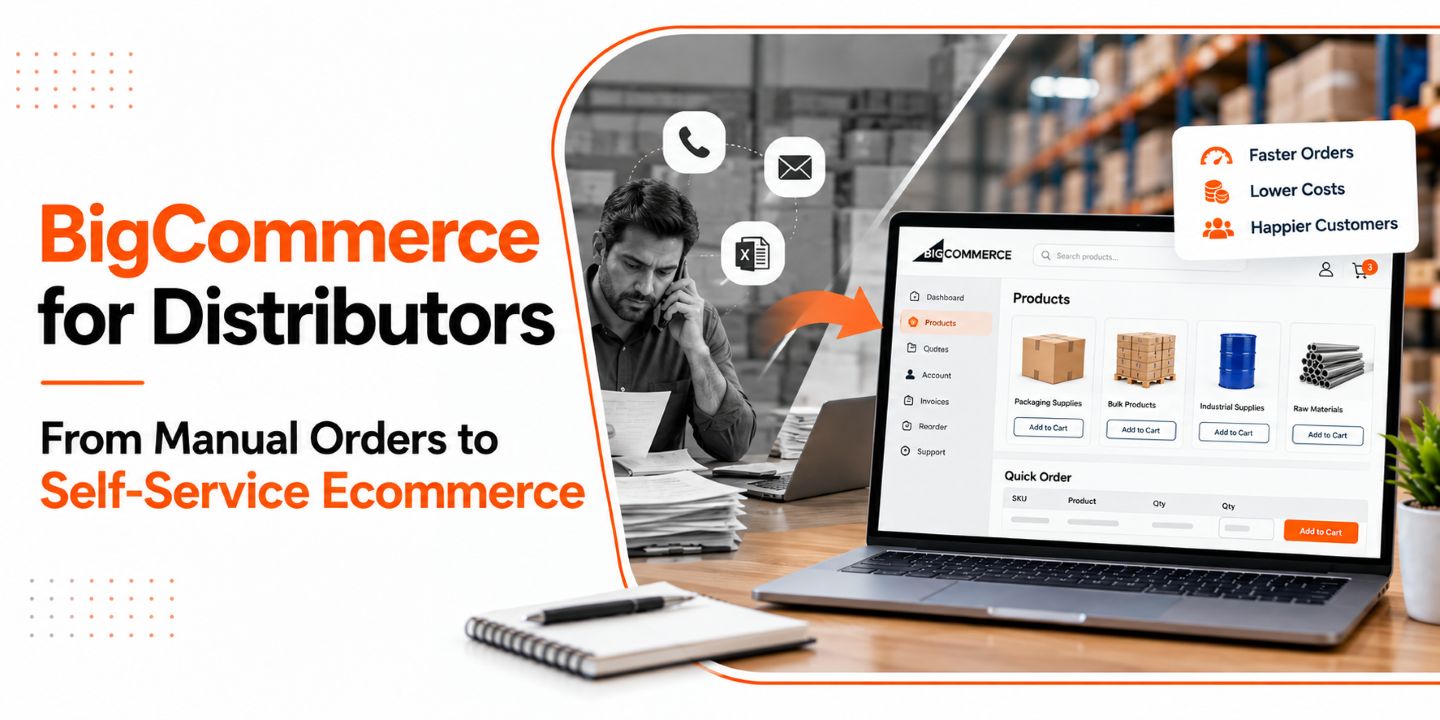
By 9:15 AM, an order is placed with the distributor via e-mail.
There is an Excel attachment of 47 SKU’s.
One member of the sales team opens it, verifies the product codes, prices agreed by the customer, checks the inventory levels, and places the order on the system.
By 11:30 AM, the customer sends another e-mail.
There is a change in one quantity required.
Further that afternoon, there is yet another e-mail sent regarding the shipping status.
Nothing extraordinary happened here. The order was duly placed.
But the thing is that quite a few people had to spend time on activities that could have been automated.
This continues to be a problem faced by distributors even today. Orders come in via e-mail, telephone calls, spreadsheets, PDF, WhatsApp and sales reps. It does happen but each new order generates additional paperwork.
BigCommerce for distributors provides an entirely different solution.
Instead of requesting the customers to contact anyone anytime they wish to place orders, distributors may provide the customers with an online ordering environment.
The customer logs into the system, finds his products, sees the prices, enters the quantities, makes his orders, and comes back later to see or repeat his orders.
The salespeople are still around.
They just don’t function anymore as the order-entry system.
Why Manual Ordering Starts Holding Distributors Back
Ordering by hand does not seem like a big deal when the business is small.
A couple dozen clients sending order emails is doable.
However, two hundred of them doing that weekly is not.
It is not just about the number of orders.
It is more about the number of small steps accompanying each order.
A client sends a PO.
A salesperson checks the client’s account.
Another person clarifies the price.
Inventory is checked.
Incorrect SKU needs to be clarified.
Order needs to be registered in the second system.
A client requests confirmation.
And then tracking.
Each of these tasks takes a few minutes.
But when multiplied by hundreds of orders, the cost becomes more visible.
There is one more aspect of the problem.
Buyers have become different.
Business buyers are using eCommerce in their everyday life.
They check inventory, compare products, order in the middle of the night, and track the order without calling anyone.
But at work, they have to send an Excel sheet in order to purchase twenty boxes of the product they have been buying for three years.
This is where the experience becomes obsolete.
Self-service B2B e-commerce does not involve transforming the distribution experience into consumer e-commerce.
The distributor will have negotiated pricing, accounts, volumes, credit terms, approval processes, and complicated products.
The concept here is to marry the B2B experience with an e-commerce order process.
What Self-Service Ordering Should Look Like
The ideal distributor website would be able to identify its customers the minute they log into the website.
They shouldn’t need to make a call to know what they are entitled to purchase and how much they cost.
Consider a building supplies distributor.
For one client, certain pricing has been agreed upon for various product categories. For another, different terms apply. Yet another client purchases products using normal wholesale prices.
Once the customers log into the website, they get an interface that is specific to them.
They will search for products using their names and SKUs.
They will see the products they are eligible to purchase.
They will enter in the quantities.
They will create a large order without having to open up many individual products pages.
In five minutes, a regular buyer will be done with it.
This is very different from sending over an excel sheet via email and waiting for a response.
Repeat Orders Become Much Easier
And repeat ordering is where self-service commerce solutions can be immediately helpful.
Distributors typically deal with clients who are going to place orders for the same goods again and again.
For example, a supplier of hotels may get almost the same order from its client each month.
The same applies to an electrical wholesaler, which receives orders for the same cables, connectors, and other stuff.
This is something an industrial supplier may face too.
Those clients don’t have to build orders from scratch.
With a good B2B solution, they can begin with previous orders or lists of products, edit quantities, and send the order.
It seems that it’s a minor change.
On a large scale, it eliminates hundreds of unnecessary emails.
The Website Shouldn’t Become Another Manual System
This is perhaps the single most critical aspect of an ecommerce distributor project.
Just because products have been put up online does not mean that there is automation.
Let’s take for instance that a distributor starts up a new ecommerce site.
Orders can be placed via the site.
Wonderful.
However, someone has to go to the trouble of manually changing product prices online.
The inventory list is updated every day with the help of spreadsheets.
Online orders are manually entered in the ERP.
Shipping details are entered separately.
You have just moved the order process.
But, you have done nothing to automate the process.
For proper functioning of self-service ecommerce, BigCommerce typically needs to integrate with the systems currently being used to run the business.
A simplified flow could be:
ERP → product, pricing and inventory information → BigCommerce
Then when the customer orders:
BigCommerce → order → ERP
And after fulfillment:
ERP / warehouse → shipment information → customer
Now the website becomes part of the business operation rather than a separate online catalog.
This is where a BigCommerce development company in India needs more than frontend experience.
The difficult part may not be designing the product page.
It may be making sure the customer sees the right price, the correct inventory is available, and the final order reaches the right backend system without somebody re-entering it.
B2B Pricing Needs to Work Online
Pricing is one of the reasons why distributors may face difficulty with ecommerce.
Pricing is simple for consumers.
A product retails for ₹1,000.
Everyone sees ₹1,000.
Distributing products is not like that.
Customer A has contract pricing.
Customer B has volume discounts.
There may be different pricing levels for dealers.
Individual customers might have negotiated pricing for specific SKUs.
Pricing based on quantities might be required for some products.
All those factors must be taken into consideration in designing the ecommerce solution.
Let’s say that Customer A has negotiated pricing of ₹760 for a product sold at ₹820 to trade customers.
What will happen if Customer A sees ₹820 upon logging in to the portal?
He/She will give a call to their sales representative.
And now you are back to manual order entry.
Your ecommerce system should mirror the existing commercial relationship with that customer.
The pricing strategy may either be managed within the commerce ecosystem or be synced from some other business system.
The critical factor is that the buyer should see pricing at which he/she can order products.
B2B Buyers Don’t Shop Like Normal Consumers
This is yet another area where many distributor websites often fall flat.
The consumer will love browsing through categories, viewing lifestyle pictures, reading reviews, and comparing products.
The purchasing manager buying 150 items will want a completely different experience.
Perhaps they already know the SKUs.
They just want to get in and get out.
Features like fast ordering, SKU searching, bulk order entry, shopping lists, and reordering could be more important for them than an elaborate homepage.
Imagine someone placing an order:
SKU 14587 – 100 pieces
SKU 27319 – 250 pieces
SKU 55104 – 80 pieces
SKU 99120 – 400 pieces
Forcing this person to navigate to four product pages separately, enter the quantity, then come back and search each time is just adding more steps.
When building a B2B experience on BigCommerce, it should be based on how the customers actually purchase.
This is also why copying the design of a great D2C site is not always the right way to go.
The customer has a different task.
What Changes for Your Sales Team?
The concern with self-ordering in B2B e-commerce is that it might lead to the diminishing role of the sales force.
Generally, it should be just the opposite.
Imagine what work a seasoned sales professional should ideally do.
They should be able to talk to key accounts, identify new business opportunities, advise on products, negotiate agreements, reanimate dormant customers, and drive business revenue.
They should not waste half of their morning copying SKUs from PDF into an order system.
Self-ordering through e-commerce can thus separate business routine from selling itself.
An existing customer making their regular weekly purchase may not need help.
A potential customer coming up with a ₹20 lakh project will definitely require help.
Your e-commerce system should cope with the former task.
While your salesforce will have more time for the latter.
This approach does not kill relationships in B2B.
It makes people have more time for those who matter.
Don’t Move Every Customer Online on Day One
The distributor that has been placing orders manually for the past 15 years cannot expect its clients to change their behavior immediately.
Work with the customers that will benefit from the process first.
Recurrent buyers are a good example.
They are familiar with the products offered by the distributor.
They have an understanding of how those products are priced.
They do not need a lot of sales support when placing their orders.
Allow them to try first.
And see what follows.
Perhaps the buyers cannot locate the products fast enough.
Perhaps the SKU lookup needs improvement.
Perhaps they need to place orders by the carton, not item by item.
Perhaps one customer has five employees that all need to access the same company account.
Perhaps purchase orders need to be approved first.
Those issues are not failures.
That is the useful data.
The idea is to make the process digital accommodate the way customers are buying.
Once you get it right, introduce more customers to it.
What a Successful BigCommerce Distributor Setup Really Achieves
The success of an ecommerce project for a distributor is not about how trendy the website appears to be.
Assess what changes in practice.
Without ecommerce, maybe 80% of orders were manually entered.
With ecommerce, maybe customers now enter orders themselves.
Without ecommerce, maybe sales people had to answer many emails regarding stock availability.
Now, customers can see what information is available on the web.
Without ecommerce, it may have taken 15 minutes of staff time to process a recurring order.
Now, customers can place a recurring order without any help.
Without ecommerce, an order went through the following steps:
Customer > Email > Sales person > ERP
With ecommerce, the following sequence is followed:
Customer > Big Commerce > ERP
This is a significant change.
For the customer – faster way to place an order.
For the company – less administration.
For sales reps – more selling.
More orders for the business with no proportional increase in manual labor.
Final Thoughts
The good news is that for distributors, digital transformation doesn’t necessarily mean tearing up all systems and turning over every customer relationship process.
Sometimes the most dramatic change can be very simple.
Stop making your clients email you so you can take an order they could just as easily place on their own.
Through the right BigCommerce B2B development implementation, your regular clients can log in, view products and prices based on their account, order in bulk, reorder their past orders, and track those orders without having to deal with your sales people.
Under the covers, BigCommerce connects to your ERP and operational systems so that order entry becomes redundant.
That’s where the efficiency comes into play.
In looking for BigCommerce development services in India, distributors should look to find a team familiar with the B2B ordering process and integrations rather than just storefront development.
Because the best distributor ecommerce implementation isn’t necessarily the one with the slickest homepage.
It’s the one where, six months later, you’re processing more orders with fewer spreadsheets, fewer emails, and significantly less data entry.
You Might Also Like...