

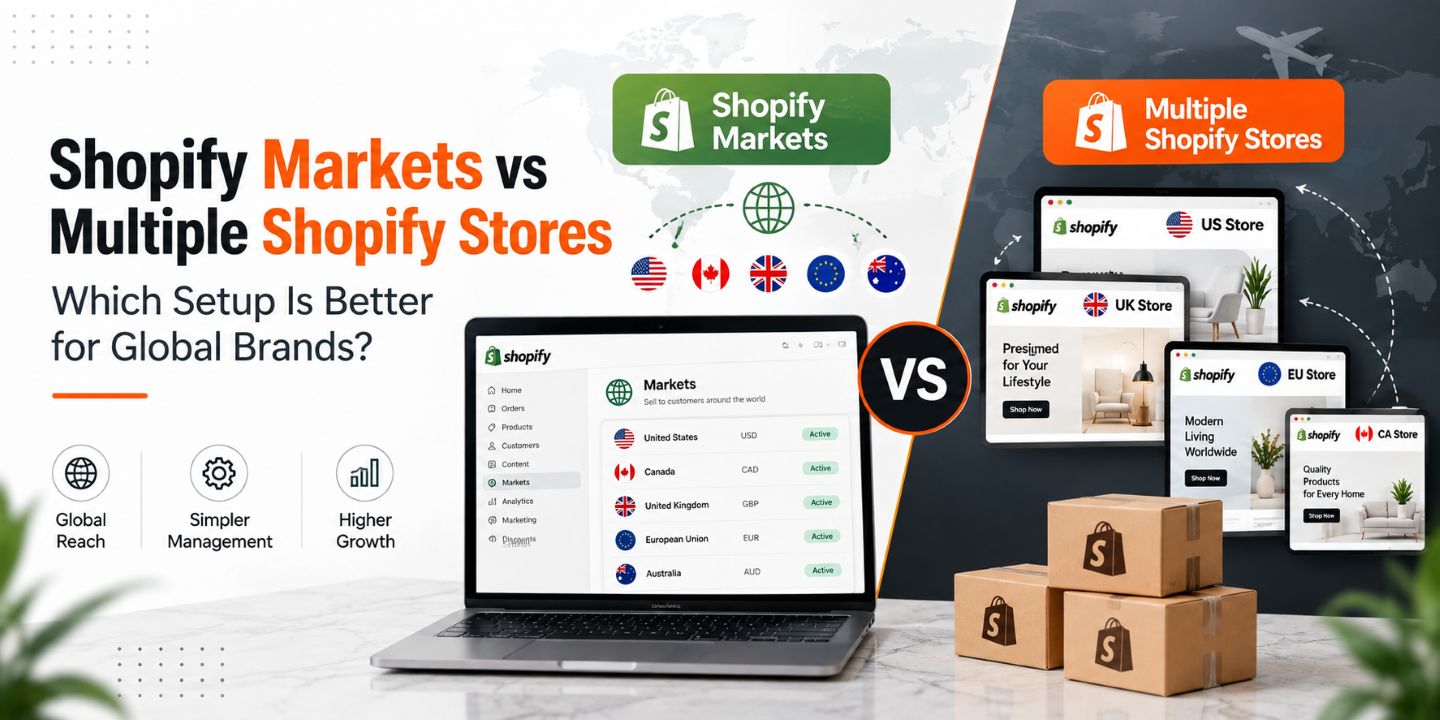
International sales seem to make sense at first glance; however, things get complicated as soon as you try to plan everything.
The successful brand in the USA could want to start selling its products in the UK, Europe, Canada, and Australia. In this case, the product assortment will stay pretty much the same, but there will be new currencies, languages, pricing, tax regulations, logistics, domains, and promotions.
Then one more question appears:
Do you want to manage your sales in these countries via Shopify Markets, or do you prefer having different Shopify stores for each of these countries?
Most brands can stick to using Shopify Markets as it will be the more convenient choice in cases where the product assortment is similar, and your business works centrally.
Shopify Markets vs Multiple Shopify Stores: Quick Comparison
Before getting into the details, here’s how the two approaches compare.
| Feature | Shopify Markets | Multiple Shopify Stores |
| Management | More centralized | Separate per store |
| International expansion | Easier | More setup required |
| Currencies | Market-based | Independent |
| Languages | Supported | Independent |
| Product catalogs | Can vary by market | Completely separate |
| Pricing | Market-specific options | Full independence |
| Design | Mostly centralized | Different theme per store |
| Apps | Easier to centralize | Often configured per store |
| Integrations | Better for shared systems | Better for regional systems |
| Reporting | More centralized | Split across stores |
| Maintenance | Lower | Higher |
| Local market control | Moderate | Very high |
| Best suited for | Similar international markets | Independent regional operations |
The main difference is pretty simple.
Shopify Markets prioritizes centralized international management. Multiple stores prioritize independence.
What Is Shopify Markets?
Shopify Markets aims to make it easier for merchants to go global without having a full Shopify store created in each country that they want to sell to.
The company could segment its customers into different markets and then customize the shopping experience for them.
For instance, a US clothing company that wants to expand into the UK, Germany, and France would not necessarily be selling totally different products.
Rather than having four separate stores, this could be managed through Shopify Markets.
The customization could include the currencies used, languages, domains, and other market-specific information depending on how the Shopify platform is configured.
This would save the brand a lot of effort especially if it has one central team handling all its ecommerce activities.
What Does Using Multiple Shopify Stores Mean?
The multiple-store strategy requires countries or regions to function out of different Shopify stores.
A single global brand may use one Shopify store for its operations in the US, one for the UK, and one for Australia.
Each of these stores will be free to have their own:
- Product catalog
- Pricing
- Promotion
- Apps
- Theme
- Integration
- Inventory configuration
- Content
- Local e-commerce team
But the flexibility comes at a price.
Each extra store means an extra environment to configure, test, maintain, and monitor.
Shopify Markets vs Multiple Stores: Where the Differences Really Matter
The choice becomes much easier once you compare how your markets actually operate.
Product Catalog and Pricing
However, if you are selling basically the same products worldwide, Shopify Markets is probably the right choice.
Let us assume you have 3,000 products and approximately 90% of them are available all around the globe. Only some items must be blocked in particular countries, as well as some price differences are needed depending on the area. Creating a duplicate of that catalog in different shops will be redundant.
Multiple shops start making sense only if there are significant differences between catalogs.
For instance, the US sells 4,000 SKUs, while Germany sells 2,500. Australia may have its own sets of products, and the UK team will decide on their own what products to release.
In such cases, separating shops will bring more benefits than difficulties.
The same applies to pricing policies.
Shopify Markets will allow for centralization of pricing and currency if you mostly require localization of pricing and currency policies.
But if each of the countries has its own approach to pricing and promotion, separation of shops will give more space for maneuvering.
Localization and Store Design
A translation of the site in itself isn’t usually enough justification for creating a separate Shopify site.
Localization takes things to the next level.
There might be differences in terms of content, images, recommendations, sizes, and offers when it comes to your German audience.
And if most of the site stays the same, there’s no problem with using Shopify Markets.
But what happens if your Australian store is having a winter promotion, while your US store is having a summer sale?
Navigation is different. Collections are different. Content on the homepage is different. The local team is in charge of merchandising.
It’s not just about translating the same store anymore.
You have two different ecommerce experiences going on.
Apps and Integrations
This is probably one of the most important aspects when it comes to bigger companies.
Think about what happens if every single country uses the same ERP system, CRM system, the same warehouse structure, the same loyalty program, and the same shipping infrastructure.
In this case, everything becomes much more manageable.
Now imagine a different scenario.
The United States is using one fulfillment system and ERP structure.
Europe is using another fulfillment system.
Australia is using a regional shipping provider.
The UK is using some other local integration processes.
Managing all regional exceptions from one architecture eventually becomes tricky.
Having separate Shopify websites helps define clear lines of separation since each region will be using a different technology stack.
That’s why consulting a Shopify development company in India becomes important at this point.
SEO
Both models can work great for SEO internationally.
Shopify Markets may work when the brand is looking for a more centralized international approach yet still offers localized experiences.
On the other hand, multiple stores give the regional teams more freedom to create completely separate SEO strategies.
This way, the UK team can use UK-based keywords, landing pages, campaigns, and content without relying much on the global store.
However, there is a catch.
With five stores, you get five different
- metadata
- redirects
- technical audit
- content
- internal linking
- schema
- SEO tracking
So separate stores offer more control, yet more SEO efforts.
Maintenance and Cost
This is where Shopify Markets usually shines.
Several stores mean several different environments.
A new feature will require development and testing in several stores.
The app might require configuration differently.
Themes will require deployment differently.
QA will need to ensure nothing broke in any market.
Themes will drift away from each other over time.
The Germans will ask for a change.
The Australians will add something.
The Brits will change the product page.
A year later, what was once one theme could have turned into several different versions.
It will require more development and maintenance effort.
Therefore, when comparing the two options, do not just look at the initial cost.
Take a look at how much you will spend on architecture maintenance over the next three to five years.
When Should You Use Shopify Markets?
Shopify Markets is generally the better choice when your international business remains mostly centralized.
It works particularly well when:
- most countries sell the same products
- branding stays consistent
- one central team manages ecommerce
- integrations are largely shared
- inventory and fulfillment are connected
- countries mainly need currency, language, pricing, and content localization
- you want to reduce duplicated development and maintenance
For a growing brand entering its first few international markets, this is often the cleaner approach.
You get international flexibility without immediately turning every country into a separate ecommerce project.
When Are Multiple Shopify Stores Better?
Multiple stores make more sense when countries operate almost like separate businesses.
For example, imagine a global retailer where:
- the US and Europe have different catalogs
- each region has its own warehouse
- local teams manage promotions
- pricing strategies are completely independent
- integrations vary by region
- storefront designs need significant differences
- different business rules apply in each country
Trying to force all of that into one centralized setup can create more complexity than it removes.
In that case, separate stores give each region the independence it actually needs.
For larger businesses using Shopify Plus, a Shopify Plus development company in India may also help plan the architecture before implementation, especially when ERP, inventory, fulfillment, and regional integrations are involved.
Can Global Brands Use a Hybrid Shopify Setup?
Yes, and for some larger brands, this can be the most sensible option.
You don’t necessarily have to choose between one global store and one store for every country.
For example:
North America Store:
US + Canada
European Store:
Germany + France + Italy + Spain
Asia-Pacific Store:
Australia + New Zealand + Singapore
Each regional store can then use Shopify Markets where appropriate.
This gives the business regional independence without creating ten or fifteen completely separate stores.
A hybrid approach is especially useful when operations differ by region rather than by individual country.
Which Setup Is Better for Your Global Brand?
First, analyze whether your markets are similar to each other.
If you have similar products, operations, brand, integrations, and e-commerce department, then usually using Shopify Markets would be the better solution for you.
It is more convenient and does not require redundant duplication.
If you have separate catalogs, warehouses, teams, integration, pricing strategy, customer experience in different countries, then usually using multiple Shopify stores will be the better option.
And if you cannot decide which option you should use, then try using regional hybrid approach.
Here is the most basic rule for that:
Similar markets -> Shopify Markets
Independent markets -> Multiple Shopify Stores
Different regional operations -> Hybrid approach
Do not create separate stores just because you operate in different countries.
Only do that if your business has significant differences between its parts.
Conclusion
Whether to go for Shopify Markets or multiple Shopify stores depends on the way your international business functions. In most cases, Shopify Markets will be the more preferable solution if products, brand, integrations, and ecommerce operations are similar for all countries, as it ensures centralization of management and lower maintenance costs.
A multiple Shopify store approach will be a better choice if each region needs its own product listing, prices, offers, integrations, or even ecommerce staff. For bigger brands with different regions, a mixed approach can be the best middle ground between centralized management and flexibility.
All in all, select the approach that fits your operations and further expansion strategy, not the number of countries you operate in.
