

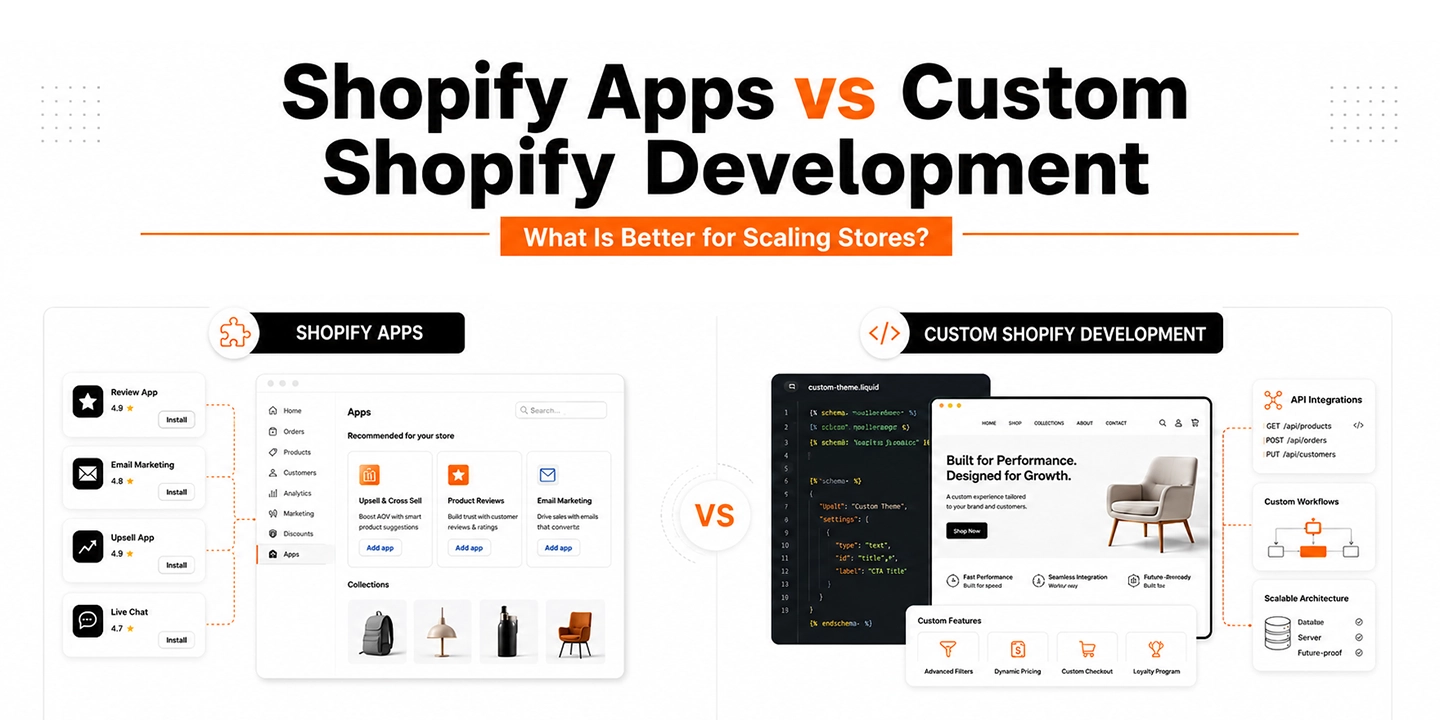
Build choice matters, a Shopify store either scales with confidence or becomes a tangle of brittle integrations and mounting costs. Stores that plan architecture early often unlock faster growth, sometimes cutting feature delivery time by roughly 55 percent compared with ad-hoc fixes. If you are weighing Shopify apps vs custom development, custom Shopify development in India should be on the short list for merchants targeting rapid, sustainable scale.
When to pick custom Shopify development in India for scalable Shopify stores
Custom Shopify development in India is not a vanity hire. It is a pragmatic route when a store needs predictable performance, complex integrations, or a distinct brand experience that off-the-shelf apps cannot deliver without trade-offs. For many merchants in Ahmedabad, Mumbai, Bangalore, and beyond, the question is not whether custom work is possible. The question is whether the extra upfront cost and lead time buy you better margins, faster checkout, or fewer support incidents six months from now.
Here are the signals that push a project toward custom development: repeated app conflicts, unique checkout flows, proprietary inventory or ERP systems, or serious traffic spikes that make app-based middleware fragile. When those boxes are checked, a well-scoped custom build from experienced Shopify developers in Ahmedabad or a Shopify development company in Ahmedabad can be a business lever rather than an engineering expense.
Quick grip: Shopify apps vs custom development, the core trade-offs
Decisions matter more as order volumes grow. Apps are fast and cheap to deploy, but they come with recurring fees, version drift, and variable performance. Custom development costs more up front, but it gives you control over performance, data ownership, and long-term maintenance costs. Below I lay out the common trade-offs so you can match investment to ambition.
Speed vs control
Apps: rapid launch, lower initial cost, and a marketplace of prebuilt features. Ideal for experimentation and early-stage stores.
Custom: longer build time, higher upfront investment, and full control over user experience and performance.
Cost profile
Apps present predictable recurring charges, often per month or per order. That can be fine for mid-size catalogs but can scale poorly with SKU counts and traffic.
Custom work is frontloaded. You pay for development and architecture once. Over three to five years, a tailored solution can be cheaper if it reduces transaction fees, minimizes app overlap, or eliminates performance-related revenue loss.
Scaling and technical debt
Apps accumulate technical debt differently. Each third-party extension is an external dependency that can update or break. Custom code centralizes ownership, but only if you maintain it. If you hire local Shopify experts in Gujarat who embed good CI, testing, and documentation, you reduce long-term fragility.
How costs and timelines typically compare
Line-item comparisons vary, so I keep this simple. In India, hourly rates and fixed-scope pricing for Shopify development are competitive, which makes custom projects attractive for regionally based merchants and international brands that want a low-cost center of gravity. Typical timelines and cost buckets for mid-complexity work look like this.
Ballpark ranges
- App-first approach, 1-3 weeks to deploy core features, monthly costs from INR 1,000 to INR 50,000 depending on stack and order volume.
- Custom development, 6-12 weeks for a polished MVP with integrations, one-time fees often between INR 3 lakh and INR 20 lakh depending on scope, plus smaller monthly hosting and maintenance fees.
Those ranges are broad because requirements vary. If your payments, fulfillment, or analytics are unique, the custom side tends to creep up. If you can accept composable app logic and some compromises, apps push you to live faster and with lower risk.
Performance, uptime, and conversion impacts
Performance is where scaling projects win or lose. Slow apps, excessive scripts, or many API calls can add page weight and increase checkout latency. That latency converts directly to lost revenue. Custom builds allow focused performance work: server-side rendering, optimized app proxies, and caching layers tuned to local traffic patterns in India and global peak times.
Local considerations for India
Indian buyers value speed as much as any market, but mobile-first patterns and intermittent connectivity make optimization vital. If your user base is India-heavy and you are scaling beyond INR 50 lakh annual GMV, investing in a stable custom stack with CDN edge caching and streamlined checkout can pay off quickly.
Integrations and data flow: why custom wins for complex systems
Many scaling stores are, in fact, integration projects. You must sync orders with an ERP, push fulfillment to multiple warehouses, reconcile marketplaces, and feed analytics to a BI system. Third-party apps help, but each comes with its own schema and latency. Custom connectors let you control batching, retry logic, and data normalization. That reduces errors and manual reconciliation work.
Practical integration checklist
- Single source of truth: ensure order and inventory truth live in one system rather than split across apps.
- Batching and rate limiting: custom code absorbs spikes so you do not hit API caps during sales.
- Monitoring, implement alerting for failed webhooks and data mismatches to protect revenue during peak days.
Maintenance, updates, and who owns the risk
There is no free lunch. With apps, the vendor owns updates and bug fixes, but you inherit their roadmap. With custom development, you own the code, which means you also own maintenance. Hiring reliable Shopify developers in Ahmedabad or a Shopify development company in Ahmedabad with a support SLA is critical if you go custom.
Operational models
Common approaches include retained support contracts, time-and-materials windows for feature work, and staged migration plans that replace apps one at a time. If your team lacks internal Shopify expertise, hire external Shopify experts in Gujarat on a retainer to avoid reactive firefighting during high-severity incidents.
Shopify apps vs custom development comparison table
| Metric | 2025 Value | 2026 Projected |
|---|---|---|
| Time to market (apps) | 2-4 weeks | 2-3 weeks |
| Time to market (custom) | 8-12 weeks | 6-10 weeks |
| Monthly recurring cost | INR 1,000-50,000 | INR 1,000-45,000 |
| Upfront cost | Low for apps | INR 3L-20L for custom |
| Customization flexibility | Limited | Full |
| Maintenance ownership | Vendor owned | Merchant owned or retained partner |
| Scalability risk | Higher if many apps | Lower with good architecture |
Use this table as a quick reality check. If you are in Ahmedabad and your volume will cross the 10k orders per month threshold in 12 months, plan for custom work or a staged migration to custom connectors.
Decision framework: choose the right hybrid path
You do not have to pick apps or custom and never revisit the choice. Most scaling brands follow a hybrid path. Start lean with apps, prove product-market fit, then replace high-risk pieces with custom components. That reduces wasted upfront spend while keeping the option to scale cleanly.
Checklist before you commit
- Measure current pain, quantify support hours spent fixing app conflicts during sales days.
- Estimate traffic and order projection, run a simple scenario for peak concurrency and API calls per minute.
- Identify single-source needs, which system must be the truth for orders and inventory.
- Budget for maintenance, include an annual maintenance line in INR if you hire local teams.
Once you have clarity on those items, compare the total cost of ownership for two to three years rather than just the implementation sprint.
Practical example: migrating a mid-size apparel store in Gujarat
Scenario and outcome
A garment brand in Surat started with a handful of Shopify apps for discounts, size management, and multi-warehouse shipping. During festivals, their checkout would slow, and inventory mismatches required manual reconciliations. They engaged a local Shopify development company in Ahmedabad to build a lightweight custom fulfillment connector, consolidate discount logic into the theme, and offload analytics to a server-side pipeline.
The result after six months: fewer checkout timeouts on peak days, a 20 percent reduction in manual reconciliation time, and predictable monthly hosting costs around INR 10,000. The brand kept several apps for low-risk features and replaced the ones that caused the most incidents. This hybrid approach saved money and reduced operational friction while keeping launch speed for marketing tests.
How to work with Shopify developers and app vendors in India
Hiring locally has advantages. Time zone alignment, easier vendor management, and lower hourly rates mean you can iterate without the friction of a stretched support window. Whether you hire Shopify developers in Ahmedabad or engage Shopify experts in Gujarat, make sure they demonstrate these capabilities.
Red flags and green flags
- Red flags, no automated tests, no rollback plan, heavy reliance on undocumented app hacks.
- Green flags, clear API error handling, modular architecture, documented runbooks for incidents, and a sensible SLA.
Ask for a deployment checklist and sample monitoring dashboard during vendor conversations. That is a quick way to separate builders who think about sustainment from those who build to ship and vanish.
Regulatory and payments notes for Indian merchants
India has rapidly evolving payments and compliance expectations. If you integrate local payment gateways, UPI flows, or marketplace settlement APIs, ensure your developers handle consent, settlement IDs, and GST reconciliation. That often favors custom connectors or carefully selected apps that support local payment rails.
Again, the right choice depends on volume and complexity. A small shop selling regionally may be fine on apps. A marketplace seller with pan-India operations needs custom flows to reconcile GST filings and returns efficiently.
Cost optimization tips when you decide to go custom
Custom does not mean expensive if you follow pragmatic rules.
- Build incrementally, replace the highest-friction app first.
- Use headless selectively, only when it unlocks a measurable conversion or performance gain.
- Automate tests, a small testing suite saves dozens of overnight incidents during peak sales.
- Negotiate support, get a modest monthly retainer with clear response times rather than unpredictable hourly billing.
These practices are particularly effective if you engage a Shopify development company in Ahmedabad that understands local commerce rhythms and international compliance expectations.
Promotion and next step
If you want a crisp, practical comparison that maps directly to your roadmap, start by capturing three things: expected peak orders per minute, critical integrations, and an acceptable downtime budget. Compare Shopify apps and custom development to choose the right approach for scaling your ecommerce store.
Conclusion
There is no universally correct answer to Shopify apps vs custom development. For early-stage merchants, apps unlock speed and low risk. For merchants planning rapid growth, high concurrency, or deep integrations, custom Shopify development in India is a strategic investment that can reduce long-term costs and improve reliability. The practical winners use a hybrid path, migrating high-risk pieces to custom connectors while keeping low-risk apps for experimentation.
If you are in Ahmedabad, Gujarat, or anywhere in India, frame the decision around projected order volumes, integration complexity, and the operational capacity to own code. Those three factors will determine whether you should hire Shopify developers in Ahmedabad, work with Shopify experts in Gujarat, or scale with apps for now. Make the choice deliberately, and you will avoid expensive rewrites when growth arrives.
