

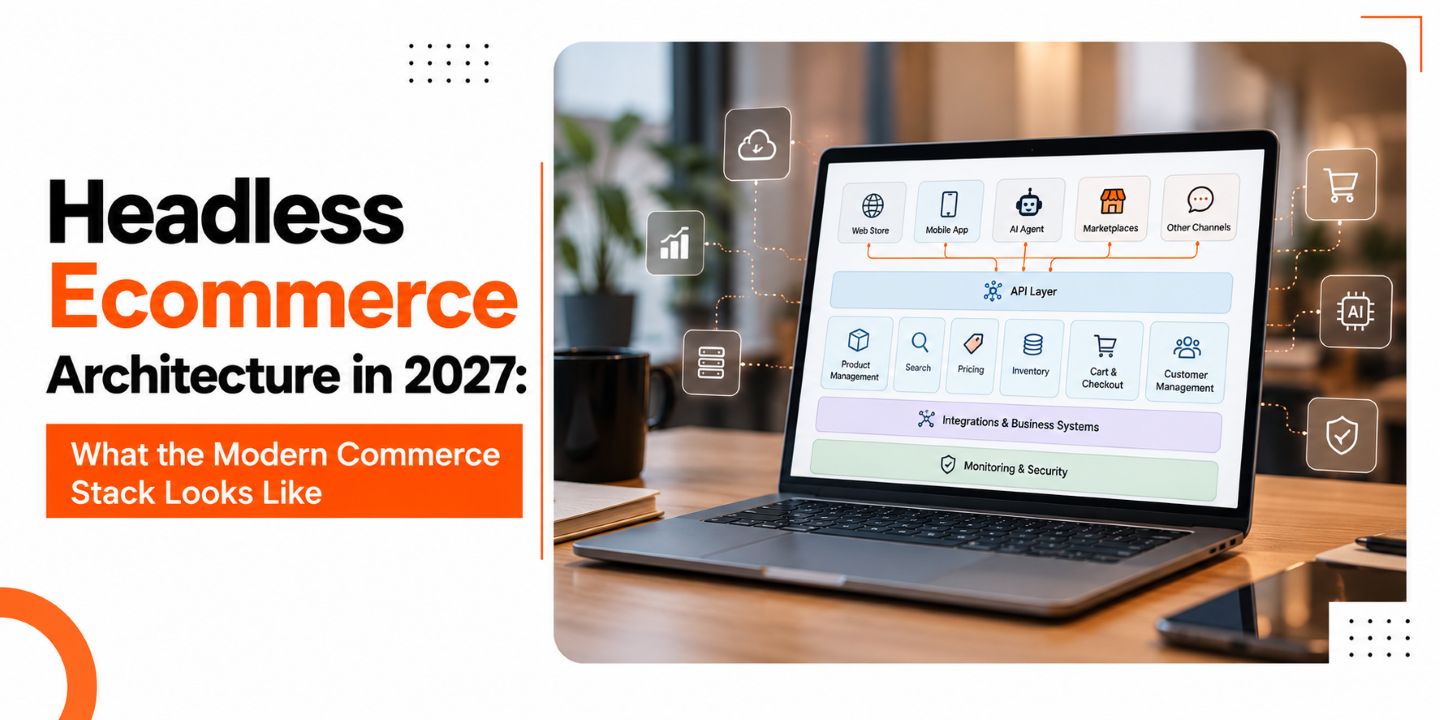
The architecture for e-commerce used to be quite straightforward.
A company would choose a platform like Shopify, BigCommerce, WooCommerce, or Adobe Commerce. This platform would be responsible for all the storefront features, products, shopping cart, checkout, customer management, and order processing. All the critical components were contained within the one software.
Such a strategy suits many companies just fine.
But not necessarily bigger e-commerce projects.
A typical modern retailer might have the product data coming from a PIM, the inventory controlled by the ERP, content stored in the CMS, searching done by yet another platform, the customer data fed to the CRM, and orders processed in the OMS or a warehouse management system.
And all that on top of the multiple touchpoints like websites, mobile applications, marketplaces, social media platforms, and even the ever-increasing number of AI-powered shopping environments.
This is where headless ecommerce architecture comes in handy.
Put simply, headless ecommerce means separating what the customer sees with what runs the underlying commerce. The frontend becomes a standalone application, and everything else, such as products, prices, shopping cart, content, searching, inventory, and order fulfillment can be served by any system via APIs.
The point is not in adding more technology.
The point is giving every aspect of ecommerce its own function.
What Does Headless Ecommerce Architecture Actually Mean?
The easiest way to understand headless commerce is to compare it with a traditional ecommerce store.
In a traditional setup, the frontend and ecommerce backend are closely connected.
A simplified architecture might look like this:
Customer → Ecommerce Store → Commerce Platform → Order
The same platform may provide the theme, product management, cart, checkout, and order management.
Headless changes that relationship.
A simplified headless ecommerce architecture looks more like:
Customer → Custom Storefront → API Layer → Commerce Services
Behind those APIs may be several systems:
Commerce Platform → products, pricing, cart, checkout, orders
CMS → homepage, landing pages, guides, editorial content
Search → product search, filters, recommendations
PIM → detailed product information
ERP / OMS → inventory, fulfillment, operational data
CRM / CDP → customer information and behavior
The customer does not know about each of those systems separately.
He only sees one experience of ecommerce.
For instance, when the customer visits the page of a running shoe,
the page is developed on Next.js.
Product details like name, SKU, price, and variations can be provided by Shopify or BigCommerce.
The detailed product descriptions could be provided by a CMS.
Search and recommendations could be provided by some other services.
And, inventory would be eventually synced with ERP.
All of this information gets combined and presented to him as one product page.
This is how headless commerce works in a nutshell.
What Does the Modern Commerce Stack Look Like in 2027?
There is no ideal stack that all businesses must follow.
This is crucial since headless commerce diagrams can sometimes imply that you need to use ten different solutions in order to sell a simple pair of shoes.
You do not.
A good headless commerce stack will use only the solutions necessary for that particular business.
An example would be this:
| Layer | Main Responsibility | Example Role |
| Storefront | Customer experience | Website or mobile app |
| Commerce Engine | Core commerce | Products, cart, pricing, orders |
| CMS | Content | Pages, campaigns, guides |
| Search | Product discovery | Search, filters, recommendations |
| PIM | Product information | Attributes, specifications, translations |
| ERP / OMS | Operations | Inventory, fulfillment, order processing |
| Payments | Transactions | Payment authorization and processing |
| CRM / CDP | Customer data | Profiles, segmentation, marketing |
| API / Middleware | Connectivity | Moves data between systems |
You don’t necessarily need all of them.
The important part is understanding who owns what.
The Storefront
The storefront is the skin layer that users interact with.
Under a headless architecture, it can be created separately through a modern frontend framework.
Thus, it allows much more flexibility in design and user experience for the organization.
A fashion company would want editorial product pages with videos and interactive lookbooks and unique navigation.
A B2B company would need fast ordering capabilities and personalized pricing along with customer accounts.
Each can do this based on a headless architecture with totally different storefronts.
The Commerce Engine
The commerce platform is still at the heart of all transactions.
Decoupling from the commerce platform does not mean replacing Shopify, BigCommerce, or any other ecommerce backend.
The commerce platform might still handle products, customers, pricing, cart, discounts, checkout, and orders.
But what changes is how the frontend interacts with it via an API and not solely dependent on the themes of the commerce platform.
This is the reason why the commerce engine must always be in charge of any transaction rules.
Let’s say that there is a 10 percent discount offered to customers in bulk when ordering more than 50 pieces.
This transaction rule must not be solely dependent on the frontend via JavaScript code.
What if the company decides to create a mobile app?
Does this mean the price logic must again be recreated in the new app?
Content, Search, and Product Information
This is where things become more flexible.
The commerce platform does not have to be able to do everything.
A CMS is capable of managing the editorial content and marketing campaigns.
An independent search solution will help with advanced product discovery.
A PIM might become the main hub for all the details about your products.
Let’s say, you are running an electronics store and selling 50,000 products.
Each of these products has a number of attributes like size, compatibility, materials used, warranty terms, technical data, regional description, etc.
Managing all this information independently on the ecommerce site, marketplaces, mobile app, and the dealer portal is quite complicated.
A PIM will keep all of this information centralized and provide it to the channels where it is needed.
Once again, not every business needs a PIM.
If you are selling only 150 products, then introducing one more enterprise-level platform to your stack of solutions will be counterproductive.
How Does Data Move Through a Headless Ecommerce Store?
Here’s where headless architecture becomes much simpler to understand.
Rather than analyzing tech stacks by their names, consider one customer journey.
Consider a person browsing through a furniture online shop and purchasing a chair.
They click on the chair page.
The frontend requests information about the product.
The commerce platform responds with product, price, and variants.
CMS provides additional purchase-related content.
Search/recommendation system might provide related products.
The person chooses a color and clicks Add to Cart.
Frontend informs the commerce platform about the action via API.
Commerce platform creates/updates the cart.
Then the customer starts checking out.
Whether the customer continues a custom checkout process or goes into the checkout hosted by the commerce platform – depends on the chosen architecture.
Payment being successful, an order is created.
Now, the front-end part is essentially complete.
But the operational side of things is just beginning.
The order should be moved to the ERP/OMS.
Warehouse needs to be informed of the purchase.
Inventory needs to be updated.
Shipping provider generates tracking data.
That information eventually travels back so the customer can see that the order has shipped.
A simplified flow looks like:
Customer
↓
Headless Storefront
↓
Commerce Platform
↓
Order Created
↓
Middleware / Integration Layer
↓
ERP or OMS
↓
Warehouse / Fulfillment
↓
Shipping Update
↓
Commerce Platform / Customer Account
To the customer, this feels like one store.
Behind the scenes, several specialized systems are working together.
That is the real meaning of a modern commerce stack.
Why Are APIs and Middleware So Important?
With ecommerce systems separated, there must be reliable means of communication among them.
This is what API does.
The storefront could ask the commerce system:
“What is the current price?”
“Is this variant available?”
“Add this product to the cart.”
“What is the customer’s order history?”
The CMS serves the content via another API.
The search engine delivers the products via yet another one.
The ERP may serve the inventory and order data via yet another interface.
This modularity requires API.
However, the reality of ecommerce integration may be much more complicated than architecture diagrams show.
Systems malfunction.
Some requests timeout.
Products have different identifiers in different systems.
Inventory is updated late.
ERP may not be available for some time.
Here comes the use of middleware.
Suppose that Shopify generates an order that needs to be sent to SAP.
Shopify and SAP have different views on customer, product, tax, and shipping data.
The middleware can go in-between:
Shopify → Middleware → SAP
The middleware then receives the order from Shopify, validates it, converts the data into a form understandable to SAP, and forwards it.
If SAP fails to respond, the middleware may log the error and retry it rather than just letting it fail.
This becomes highly critical as the architecture expands.
Without an adequate integration approach, a flexible headless setup may easily become a set of brittle connections.
Why Are Businesses Moving Toward Headless Commerce?
Headless commerce’s greatest advantage is not just the speed of its site and the use of an up-to-date JavaScript framework.
It is the independence of systems from one another.
For instance, consider a classic ecommerce company that needs to make a complete redesign of its storefront.
In a tightly coupled approach, such changes will likely affect major portions of the ecommerce system itself.
However, in the case of headless commerce, a new frontend can be introduced without significant changes in the commerce backend.
The concept also applies in the opposite direction.
Perhaps the business decided to swap out its search solution.
It shouldn’t involve rewriting the checkout process.
Or maybe it needs a new content management system.
It shouldn’t involve changing the ERP.
Or perhaps it introduced a mobile application.
The mobile application could take advantage of the same commerce APIs that were serving the website.
This feature proves especially useful for multi-channel ecommerce companies.
An ecommerce company might have:
Website
Mobile App
B2B Portal
In-store Kiosk
AI Shopping Assistant
All of them have the ability to interact with the same commerce functionality.
This becomes a lot harder when critical business logic is present only within one storefront.
Being headless also allows for greater flexibility on the frontend side of things.
The team can create experiences that could not be accommodated by traditional ecommerce themes.
But the downside of that is increased responsibility on the side of the business.
Headless Ecommerce vs Traditional Ecommerce
Headless isn’t automatically the better option.
For many stores, traditional ecommerce is still the smarter choice.
| Traditional Ecommerce | Headless Ecommerce |
| Frontend and backend connected | Frontend and backend separated |
| Faster to launch | More development required |
| Lower technical complexity | More architectural complexity |
| Platform theme controls frontend | Custom frontend |
| Fewer integrations | Often more integrations |
| Easier maintenance | Requires stronger technical ownership |
| Good for standard ecommerce | Better for complex experiences |
| Lower initial cost | Usually higher initial investment |
Consider a brand selling 300 products in one country.
It has a default checkout process.
It has no complicated ERP integrations.
It has just one website without mobile apps.
This scenario may offer no benefits for such an enterprise going headless at all.
Now consider a retailer who operates in 15 countries selling 100,000 products and working with several warehouses, PIM, ERP, CMS, mobile apps, B2B portal, and advanced search.
Here the situation is absolutely different.
In this case, a good headless ecommerce approach will definitely improve the whole ecosystem evolution.
And here the question should not be:
“Is headless better?”
It should be:
“Does headless solve the problem we have?”
What Changes in Headless Ecommerce Architecture in 2027?
The concept of headless commerce itself is not new.
What is evolving is what has to integrate with the commerce stack.
Just a few years back, the focus of the debate was on decoupling the frontend website from the ecommerce backend.
However, by 2027, the architecture has evolved.
Commerce has to embrace new channels, greater automation, and AI-based customer experience.
AI Becomes Another Commerce Interface
Think about an AI shopping assistant.
A customer says:
“Find me a waterproof hiking jacket under $200 that can arrive before Friday.”
To answer properly, the AI may need:
- product information
- price
- size
- material
- inventory
- customer location
- delivery availability
That information already exists somewhere in the commerce stack.
A modular architecture makes it easier to expose those capabilities to new interfaces without rebuilding the entire commerce system.
The website may no longer be the only frontend.
An AI assistant can effectively become another interface consuming commerce services.
The Stack Becomes More Composable
Businesses are also becoming more selective about technology.
Instead of replacing the entire ecommerce platform whenever one feature becomes limiting, they can replace individual components.
Maybe the commerce engine stays.
The search platform changes.
Later, the CMS changes.
The storefront gets rebuilt.
The ERP remains untouched.
This is the idea behind composable commerce.
The business can evolve individual parts of the stack rather than treating ecommerce as one giant system that must always move together.
But there’s an important warning here.
Composable doesn’t mean:
“Buy as many different platforms as possible.”
Every new component creates another contract, integration, API, failure point, and maintenance responsibility.
Good architecture is about choosing the right components, not the largest number of them.
When Does Headless Ecommerce Make Sense?
Headless commerce works best if flexibility justifies the added complexity.
It could be a good choice if there are multiple channels, personalized experience, complex integration, large catalog, complex content management or multiple regional storefronts.
It could also be used if you need to adjust some components of your stack independently from others.
But if the current ecommerce platform is enough for your needs, then there’s no point in switching to headless.
That’s where businesses tend to be misled by buzz around technologies.
There are all kinds of buzzwords like Next.js, composable commerce, microservices, headless CMS platforms and AI.
All of a sudden your current store looks out of date even if it meets all the requirements.
But this is not a reason for reconstruction.
The right way to launch a headless ecommerce development project is by starting with a business limitation.
For example:
“Our mobile app and website should have the same commerce logic.”
“Our current CMS is restricting our content team.”
“Our storefront should have experiences that are impossible to implement with our theme.”
“We need one commerce backend on multiple customer channels.”
These are the architectural limitations.
“Headsless sounds modern” is not.
Final Thoughts
Understanding headless commerce architecture in 2027 becomes easier once we get rid of thinking about it in terms of technologies.
Think about responsibilities instead.
The storefront takes care of the customer experience.
The commerce platform deals with products, carts, pricing, checkout, and orders.
The CMS manages content.
The search platform is responsible for discovery.
There may be a PIM managing product data.
ERP or OMS manages inventory and fulfillment.
APIs and middleware make it all communicate.
And the new channels, such as mobile apps and shopping assistants, can take advantage of all that commerce functionality.
That’s why headless commerce architectures are useful.
You can update some part of the system without rebuilding it from scratch.
However, that flexibility comes at a price.
A headless store will require more development, integration, testing, and technical ownership than a regular ecommerce.
Therefore, the ideal headless ecommerce architecture is not the one with the most number of technologies.
It is the one that provides the business with the right amount of flexibility but without unnecessary complexity.
