

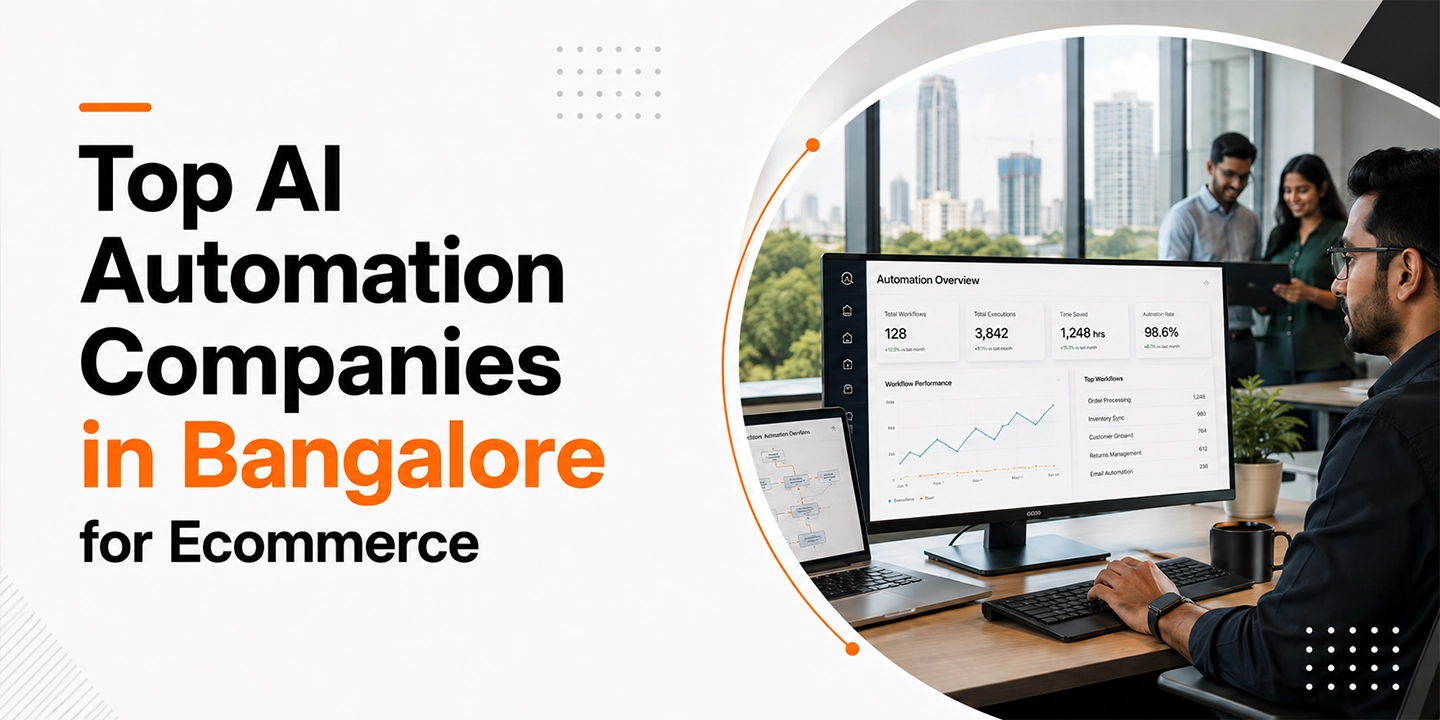
Ecommerce teams are leveraging AI automation technology to eliminate repetitive tasks in customer service, marketing, reporting, inventory, order management, and internal operations. The idea is not to automate all processes. Rather, it involves eliminating manual tasks which delay the team.

For companies assessing AI automation vendors in Bangalore, it is important to look for expertise in both ecommerce and AI technologies. A vendor should be able to understand how a store platform works, APIs, CRM system, orders, customer information, and the effect of failure in a workflow process.

Some companies to consider in 2026 include 9eCommerce, DIT India, DIT Interactive, DigiOn Solutions, CAMSDATA, FuGenX Technologies, and Solid. Note that the above companies range from Bangalore-based firms to those offering remote assistance for Bangalore ecommerce businesses.

According to a McKinsey survey conducted in 2025, Shopify claims that 88% of organizations surveyed were applying AI in one way or another in one business function.

Where AI Automation Helps Ecommerce Businesses

AI automation can support both customer-facing and operational work. Shopify identifies areas Such as email marketing, order fulfillment, customer service, and payments as practical ecommerce automation examples. 

Typical workflows include:

  • Customer support and status inquiry
  • Recommendations and segmentation
  • Abandoned cart and CRM follow-ups
  • Inventory and low stock alerts
  • Order and fulfillment alerts
  • Product data processing
  • Marketing analytics
  • Reviews and feedback analysis
  • Returns workflows
  • Sales and operations analytics

Salesforce also finds that 82% of organizations who use AI for commerce experience at least some improvement in product discovery, proving that AI can affect not only efficiency but also customer experience.

How We Reviewed These Companies

Analysis of the businesses was carried out based on publicly available information concerning their artificial intelligence, automation, e-commerce, case studies, and services.

The analysis takes into consideration factors such as the significance to e-commerce, AI development, workflow automation, integration, customer support, CRM integration, reporting, and operational automation. When a business does not publicly demonstrate an AI automation service for e-commerce, the fact is stated.

1. 9eCommerce

9eCommerce is an ecommerce development firm that specializes in building ecommerce sites on platforms including Shopify, BigCommerce, Magento, and WooCommerce. In its latest content, they talk about AI-based recommendations, email automation, personalization of products, inventory management, and behavioral analysis for ecommerce development.

The company has a relatively better position in terms of ecommerce development rather than AI automation alone.

Ecommerce Automation Focus: Store workflows, product experiences, integrations, personalization, and ecommerce process improvement.

AI Capabilities: AI-assisted ecommerce, recommendations, workflow automation concepts, inventory automation, customer personalization.

Suitable For: Ecommerce brands that need automation considered as part of a broader Shopify, BigCommerce, Magento, or WooCommerce development project.

2. DIT India

The DIT India team blends their expertise in ecommerce software development with an increasing interest in applying AI to automate ecommerce operations. The materials of the 2026 ecommerce automation include customer service, order management, cataloging, tagging products, recommendations, search engines, cart recovery, segmentation, emails, stock levels, reports, and integration with other business systems.

The DIT India ecommerce background will be helpful when automating operations on ecommerce platforms such as Shopify or BigCommerce.

Ecommerce Automation Focus: Store operations, support, inventory, reporting, merchandising, and connected ecommerce workflows.

AI Capabilities: Ecommerce AI automation, agentic workflows, Shopify automation, data processing, system integrations.

Suitable For: Ecommerce brands looking to connect AI automation with existing Shopify, BigCommerce, CRM, inventory, or operational workflows.

3. DIT Interactive

DIT Interactive has a specialty of AI workflow automation and agentic AI in addition to its expertise in ecommerce development. DIT Interactive agent development involves workflow analysis, AI-agent design, OpenAI, LangChain, n8n, custom APIs, testing, controls, deployment, and monitoring.

Some examples of real workflows using n8n by DIT Interactive include automatic reporting, email follow-ups, social analytics, and BigCommerce workflows.

Ecommerce Automation Focus: Ecommerce operations, AI agents, reporting, CRM workflows, marketing, support, and custom integrations.

AI Capabilities: n8n, AI agents, OpenAI, LangChain, custom APIs, workflow automation.

Suitable For: Ecommerce businesses that need custom AI workflows connected to multiple systems rather than standalone AI tools.

4. DigiOn Solutions

DigiOn Solutions is a company based out of Bangalore that specializes in digital marketing and AI automation. The current products of the company include AI automation services along with marketing, analytics, web development, lead generation, and campaigns.

In addition to this, DigiOn provides WhatsApp chatbots powered by AI that can automatically manage customer support, qualification of leads, notifications, and routing of data for sales/CRM.

Therefore, its automation services are particularly useful for customer communication and marketing-led ecommerce.

Ecommerce Automation Focus: Customer communication, lead handling, marketing automation, CRM workflows, and notifications.

AI Capabilities: AI automation, WhatsApp chatbots, lead qualification, customer support automation, marketing automation.

Suitable For: D2C and ecommerce businesses focused on automating customer engagement, leads, campaigns, and communication.

5. CAMSDATA

CAMSDATA is a firm from Bangalore that provides services in AI development through customized AI solutions, AI consultancy, AI integration, automation, and AI maintenance. CAMSDATA’s AI practice involves several areas including NLP, predictive analytics, machine learning, and automation.

Regarding retail and ecommerce, CAMSDATA specifies the use of AI in recommendation engines, targeted marketing, supply chain optimization, demand prediction, and personalized shopping. CAMSDATA also includes an ecommerce recommendation case study in their list of published AI case studies.

Ecommerce Automation Focus: Recommendations, forecasting, personalization, supply chain, and AI-driven customer experience.

AI Capabilities: Custom AI, machine learning, predictive analytics, NLP, AI automation.

Suitable For: Retailers and ecommerce companies that need custom AI applications or data-driven automation rather than only no-code workflows.

6. FuGenX Technologies

FuGenX Technologies has its presence in Bangalore and provides AI, Machine Learning, and automation services in various verticals such as ecommerce and retail. Its automation services include business processes, CRM, ERP, Sales, Marketing, Analytics, and Retail.

FuGenX provides AI applications and states that ecommerce is one of the verticals where its automation and AI skills can be used. 

This makes it more relevant to consider FuGenX Technologies in scenarios where automation is one of the components in technology projects.

Ecommerce Automation Focus: Business processes, retail operations, CRM, sales, marketing, and analytics.

AI Capabilities: AI development, machine learning, process automation, CRM/ERP automation, marketing automation.

Suitable For: Larger retailers or ecommerce companies that need AI automation connected with broader custom software and business systems.

7. Solid

Solid runs an AI-based automation practice out of Bangalore that aims to automate repetitive manual processes through connected automation. This solution comprises of workflow design, AI agents, CRM integration, data pipelines, reporting, customer support, lead generation, and automation management.

In e-commerce, Solid includes order management, inventory management, shipping alerts, returns management, customer communications, and customer retention in their list of automation use cases.

Ecommerce Automation Focus: Orders, inventory, support, customer retention, reporting, and back-office operations.

AI Capabilities: AI agents, workflow architecture, CRM integration, reporting automation, customer support automation.

Suitable For: Ecommerce and D2C brands looking to automate several operational workflows rather than implement one isolated AI feature.

Quick AI Automation Company Comparison

Company Ecommerce Automation Focus Suitable For
9eCommerce Ecommerce workflows and integrations Platform-led ecommerce projects
DIT India Operations and store automation Shopify and BigCommerce brands
DIT Interactive AI agents and workflow automation Custom multi-system automation
DigiOn Solutions Customer and marketing automation D2C and marketing-led brands
CAMSDATA AI applications and prediction Data-driven retail businesses
FuGenX Technologies Process and retail automation Larger technology projects
Solid Orders and operational workflows Ecommerce and D2C operations

What to Check Before Hiring an AI Automation Company

Never select an automation vendor by AI demos alone.

Consider if the vendor understands your ecommerce platform, CRM, ERP, APIs, and current processes. Additionally, learn how to deal with failure, duplication of actions, poor data, and manual approvals.

Sample questions are:

  • How does the process work if there’s an error in the API?
  • Which actions should go through human approval?
  • How do you track errors?
  • Who monitors the workflows post launch?
  • Is the process flexible for future adjustments?
  • How do you ensure customer data security?

In my opinion, an unexciting automation that runs daily is better than an amazing AI demo nobody can use in production.

Conclusion

When deciding which AI automation companies in Bangalore will be right for you, your starting point should be your workflow itself.

The two clear options for workflow automation are DIT Interactive and Solid, while CAMSDATA and FuGenX offer more generalized AI development services. DigiOn has a more marketing-oriented approach, while DIT India and 9eCommerce have ecommerce platform knowledge that may prove valuable if the automation needs to operate within an existing store environment.

It makes sense to look at experience with e-commerce, error handling, integration capabilities, monitoring, security, and support after launch. The aim is effective automation that will save you time and effort – not simply AI for AI’s sake.
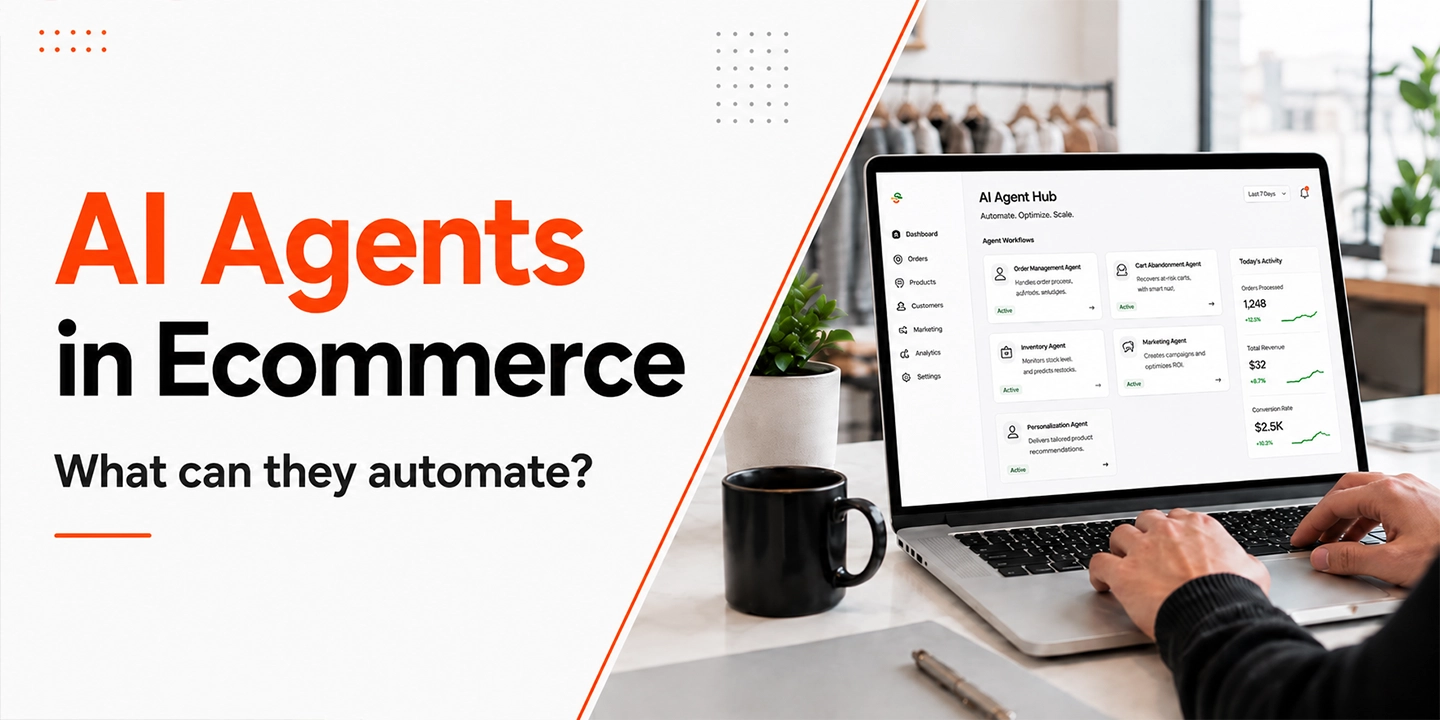
AI-based agents are starting to become one of the most talked-about solutions for ecommerce, but there’s still a lot of misconceptions about what they really do.

An AI agent is not simply an assistant that can answer a customer’s question. An adequately programmed agent will be able to comprehend the task, obtain data from the ecommerce and business systems, make decisions based on some specific rules, perform the necessary actions and continue the workflow without any manual intervention.

For ecommerce company, that would imply qualification of the customer, checking the inventory, updating CRM, return analysis, report generation, handling of support requests, and coordination of actions between Shopify, BigCommerce, ERP, warehouse, and marketing systems.

What makes developing AI agents for ecommerce interesting is not the fact of replacing employees. It minimizes the amount of redundant tasks between the customer’s request and performing the necessary action.

What Is an AI Agent in Ecommerce?

AI agent for an ecommerce store is software that is capable of recognizing a goal, retrieving the appropriate information from the business, deciding what the allowed action should be, and taking the action(s) through connected tools or APIs. As opposed to a simple chatbot, an agent has the capability to take actions based on information as opposed to answering questions.

Consider a normal support chatbot for instance.

Customer: “Where is my order?”

Chatbot response: “Click here to see the order tracking page.”

But an AI agent can do much more.

It may recognize the customer, fetch the order from Shopify, query the carrier API, learn that the delivery has been delayed, communicate the same to the customer, create a support ticket, update the CRM, and inform an employee if the delay exceeds a certain threshold.

This is the distinction.

One system primarily responds while the other can comprehend, decide, and take actions.

Why Ecommerce Businesses Are Paying Attention to AI Agents

AI technology is now starting to affect ecommerce processes and how consumers purchase goods.

According to Shopify, in 2026, the conversion rate of visitors from AI channels was 50% greater than that of organic-search visitors. At the same time, the value of orders of those coming via AI was 14% greater. Orders from AI channels have increased almost 13 times year over year in Q1 2026.

Salesforce uncovered another interesting fact in the 2025 holiday season. The influence of AI and agents contributed to $262 billion of global holiday spendings, showing that AI affects product discovery, recommendations, service, and purchase processes.

According to McKinsey, AI agents could facilitate between $3 trillion and $5 trillion of global consumer commerce by 2030 even in a scenario of moderate adoption.

These figures do not imply that retailers should immediately employ dozens of AI agents.

Honesty requires us to say that this might cause more issues than benefits.

However, it shows that AI is getting closer to real commerce processes and operations.

Here are two types of agents that retailers should consider using:

Customer-facing agents, which help people discover, compare, and purchase products.

Business-facing agents, which help people within the business operate the organization

What Can AI Agents Actually Automate in Ecommerce?

The best ecommerce agent use cases usually involve processes where employees repeatedly collect information, check several systems, make a predictable decision, and then perform an action.

An agent can often reduce those steps.

Customer Support and Order Questions

Customer service is the simplest aspect to comprehend.

An AI representative will be able to rely upon:

  • Order details
  • Product information
  • Shipments’ statuses
  • Policies of the shop
  • History of the customer
  • Help center information
  • CRM information

The representative will not have to give an identical, generic response to every customer because he/she will be able to answer the customer taking into account his/her unique situation.

For instance:

“Your package was supposed to arrive yesterday, but I don’t know where it is. Can you check on that?”

In this case, a support representative will be able to find the order, track the shipment, ask the delivery company about the problem, and determine whether escalation is required.

All usual cases will stay automated.

Only unusual cases will be handled by a human.

And it’s important.

The idea is not to prevent customers from contacting humans. The idea is to prevent humans from spending half their day handling cases that software can solve perfectly.

Product Discovery and Recommendations

Moreover, AI agents are able to alter the way customers browse through catalogs.

Ecommerce navigation assumes the customer will be familiar with categories, filters, and the jargon of products.

Sometimes this is not the case.

The person who is looking for skincare may say:

“I have sensitive skin and pigmentation. I want a quick morning routine below $100.”

The traditional search engine may not work because the customer is not trying to find a certain SKU.

The AI shopping agent, however, is able to comprehend the following:

  • The customer’s problems
  • The budget
  • Product compatibility
  • Customer preferences
  • Product characteristics
  • Availability

Then, the agent will suggest products corresponding to the above criteria.

At the moment, Shopify refers to agentic commerce as an approach when AI agents are able to find, assess, and purchase products on behalf of the customer.

For merchants, this means that the focus is put much more on having clean catalogs.

How can the agent make a recommendation if the merchant itself does not specify the size, ingredients, specifications, product compatibility, pricing, inventory, or shipping?

Merchandising and Catalog Management

The size of ecommerce catalogs creates a lot of repetitive effort.

For example, merchandising staff might need to handle:

  • Product titles
  • Categories
  • Attributes
  • Tags
  • Collections
  • Pricing
  • Promotions
  • Inventory
  • Relationships between products

And an AI agent can help them do many of these chores.

Consider a retailer who adds 2,000 new products from a supplier.

Instead of doing the same categorization over and over for all those SKUs, an agent can parse product descriptions, spot likely categories, set attributes, apply tags, and even raise flags when there is a lack of information about certain products.

Then a merchandiser reviews any exceptions.

It’s a lot better way to spend humans’ time than repeating the same classification decision over 2,000 times.

McKinsey has actually called out merchandising as one area where agents can reduce reporting and analysis effort, leaving merchants to do more decision-making and strategizing.

Inventory Monitoring and Replenishment

IInventory is yet another example where a single notification will not be sufficient.

Traditional automation will state the following:

If inventory is below 20, inform purchasing.

AI will take into consideration the following factors:

  • Current inventory
  • Sales speed
  • Supplier delivery time
  • Past demand
  • Future promotion plans
  • Open orders
  • Seasonality

For one product, having 20 units in inventory will be completely fine if sales happen twice a month.

For another product, having 100 units in inventory could be dangerous if sales occur at the speed of 40 units a day.

This product will be prioritized by the agent for human decision making.

Will I permit an AI agent to place a significant order without any approval from my side?

Most probably not.

What I will let the agent do is make the suggestion and calculate the optimal amount of goods and then place the order request for approval.

CRM and Customer Lifecycle Management

There is a vast quantity of data about customers collected by ecommerce professionals, yet much of it is left unused due to information fragmentation.

An AI agent will be able to identify a valuable purchase and:

  • Gather the customer’s history.
  • Review their past transactions.
  • Update the CRM.
  • Determine the customer’s segment.
  • Plan a subsequent action.
  • Assign the appropriate staff member.
  • Schedule the follow-up action.

And all of this proves very helpful for B2B ecommerce.

Each online purchase can also mean an opportunity for a sale.

For instance, when a new company purchases $15,000 worth of goods wholesale, an account manager should be informed about that instead of being considered a regular $20 consumer product buyer.

The agent brings some context into the picture.

Returns and Refund Processing

Returns include a remarkable amount of recurring decision-making.

A standard workflow might involve asking an employee to verify:

  • Order date
  • Product
  • Return window
  • Condition of the item
  • Customer history
  • Reason for return
  • Amount of refund

The system is able to extract all this information automatically and decide if it conforms to regular policy conditions.

In case of a regular and low-dollar value return, it could automatically approve the return authorization.

However, in case of an exception, like frequent high-dollar value returns or disputes about the product’s condition, it would forward that return request to the employee.

And that’s where the human in the loop comes in handy.

You don’t need a person verifying each $25 return.

You certainly want a person evaluating a $5,000 refund.

Review and Customer Feedback Analysis

Feedback from customers provides product information that is helpful for business organizations; however, they do not have sufficient time to read customer feedback thoroughly.

AI-based agents can always analyze:

  • Product reviews
  • Customer support interactions
  • Reasons for returns
  • Surveys
  • Customer emails

The agent will be able to spot the recurring trends.

For instance:

“Mentions of damaged packaging increased by 37% this week in three product SKUs.”

This type of data is much better than just having a sentiment score.

The good agent will also be able to find out the relevant products, compare fulfillment centers, and alert operations.

Notice once again the key difference.

AI is doing something else apart from summarizing the information.

Ecommerce Reporting and Operations

It seems very easy at first, but once you look at how teams actually operate, it’s not that easy.

  • One person takes Shopify data out.
  • Another person looks at Google Analytics.
  • Marketing sends information about advertising performance.
  • The Operations team reviews returns.
  • The Finance team looks at revenues.

And finally, one person compiles everything on a spreadsheet for the weekly meeting on Monday.

An AI agent can pull information from all these systems and compile a daily or weekly business report.

Not just saying:

Revenues up by 8%.

But giving you the insight to understand why:

Revenues up by 8% due to increased order volume, with average order value staying the same and increased returns from two new products introduced a month ago.

More insightful.

Employees can go straight to analysis without wasting an hour pulling numbers.

Marketing and Retention Workflows

Agents could also help the ecommerce teams in deciding which customer journey will follow.

Imagine three customers who have not made any purchases in 90 days.

Customer A makes one purchase each year.

Customer B makes a purchase every month.

Customer C has recently filed a very important support issue.

What an automated process would likely do is send the same “We miss you” discount to all of them.

An AI agent could make sense of the context.

Customer A does not need anything.

Customer B could be a churn candidate.

Customer C should not be sent a bright promotional message until the support issue gets sorted out.

The key here is that personalization is not about adding someone’s first name to an email.

Connecting Ecommerce, ERP, CRM, and Warehouse Systems

This is where AI agent development gets really technical.

Well-established ecommerce companies do not function on one platform.

A typical architecture might consist of:

  • Shopify or BigCommerce
  • ERP
  • CRM
  • PIM
  • WMS
  • Customer service application
  • Marketing automation
  • Shipment management application
  • Financials

An AI agent can play a role in the orchestration of the above technologies.

Let’s say there is an order but there is no inventory available to fulfill that order.

The system can check another warehouse, see if the other warehouse can fulfill the order, calculate the effects of shipping, and initiate the appropriate action.

But there should be no dependency on AI in the actual architecture.

That is key.

All reliable actions, like updating inventory, making payments, and changing order status, should still make use of deterministic APIs and business rules where applicable.

AI should be used for tasks requiring interpretation.

AI Agents vs Traditional Ecommerce Automation

E-commerce automation using traditional techniques is based on pre-set guidelines, whereas AI agents have the ability to comprehend information and select from among the allowed actions. All e-commerce enterprises must use both techniques. The rigid workflow is more appropriate for a routine transaction, while AI agents are helpful when the process involves language, context, analysis, and change.

Traditional Automation AI Agent
Follows fixed rules Interprets context
Predictable output Can choose between actions
Works well with structured data Can work with unstructured information
Good for status updates Good for reasoning and classification
Easier to test Requires stronger monitoring
Little autonomy Controlled autonomy

There’s no reason to replace reliable automation simply because AI agents are newer.

If the rule is:

When payment succeeds, mark the order as paid.

Use the rule.

You don’t need an AI model debating what “paid” means.

What Should Ecommerce Businesses Not Give AI Agents Full Control Over?

AI agents must not usually be given unrestricted power to take important financial, legal, security, and customer decisions. Important actions must incorporate permission constraints, business rules, threshold approvals, audit, and human review such that a wrong decision by the AI system cannot immediately become an expensive action taken by the business.

Autonomy would worry me with respect to:

  • Significant refunds
  • Important price changes
  • Purchases from suppliers
  • Closure of fraud accounts
  • Credit decisions
  • Litigation issues
  • Sensitive customer data
  • Important B2B contracts
  • Significant promotional discounts

An appropriate design would give the agent the ability to make recommendations on $20,000 purchases from the supplier but mandate the employee to approve the action.

The agent may also perform an automatic replacement of the purchased item at $5 whenever business policies permit it.

Different risks warrant different levels of autonomy.

What Does AI Agent Development for Ecommerce Actually Require?

The process of building an ecommerce agent is a lot more complex than plugging in a large language model to Shopify.

For one, the system typically requires:

Reliable data. Information related to product, orders, customers, inventory, and policies should be correct.

APIs and integrations. Controlled access to the systems where something is going to happen.

Business rules. Clearly defined boundaries of what the system can and cannot do.

Permissions. A customer service agent shouldn’t have the same level of permissions as a finance system.

Human escalation. It should be clear where and how the system should stop and seek assistance.

Monitoring. Businesses should be able to see what the system did and why.

Fallback logic. Any API can break at any moment, and any data can be missing. The production system must be ready for that.

It is the reason why building a proof of concept for an AI agent takes days, while a reliable production system requires a lot of thinking.

In my experience, the problem is not building an intelligent response from a model.

It is making sure the workflow around it behaves in the right way in case of ecommerce edge cases.

Where Should an Ecommerce Business Start?

Avoid beginning with the question:

“How many AI agents can we create?”

Instead ask yourself:

“Where are people doing repeatable tasks without much decision-making?”

Look for tasks with:

  • Repetition
  • Manual testing of systems
  • Repeatable decisions
  • Employee time investment
  • Data available
  • Measurements to make

Processes like customer support, reporting, catalog organization, CRM updates, review analysis, and inventory notifications are good places to start.

And then measure something specific.

Time savings.

  • Speed.
  • No tickets created.
  • Process time.
  • Errors prevented.
  • Money recouped.

If your agent isn’t improving a measurable business metric, you shouldn’t add more AI.

Final Thoughts

AI agents can do far more than engage in conversations with customers.

They can perform information lookup, interpret context, system coordination, decision making, and action execution within support, merchandising, inventory, CRM, marketing, returns, analytics, and ecommerce functions.

However, developing AI agents for ecommerce is not about providing the greatest level of autonomy for software.

It is about identifying where and when autonomy works.

Employ rigid automation when the task is clear-cut. Deploy AI agents when interpretation adds value. Keep people in the loop when the risks of a financial, legal, or reputational nature are high.

Companies that understand how to do it well will not have the largest number of agents.

They will have only a few useful agents interacting with quality data, effective APIs, and sound business rules.

Frequently Asked Questions

What is AI agent development for ecommerce?

AI agent development for ecommerce involves building software agents that can understand tasks, access ecommerce and business data, make controlled decisions, and perform actions through APIs or connected tools. Agents can work with systems such as Shopify, BigCommerce, CRM platforms, ERP software, warehouses, and customer-support applications.

How are AI agents different from ecommerce chatbots?

A chatbot primarily communicates with users, while an AI agent can also perform actions. For example, a chatbot may explain a return policy. An agent could check the customer’s order, verify return eligibility, create a return request, update the CRM, and escalate unusual cases to an employee.

Can AI agents manage ecommerce customer support?

Yes. AI agents can handle routine order questions, product information, shipping queries, return eligibility, account questions, and support classification. They work best when connected to real order and customer data. Sensitive complaints, large refunds, and unusual cases should still have a clear route to human support.

Can AI agents make product recommendations?

Yes. AI agents can interpret natural-language requests and match them with catalog information, customer preferences, budgets, inventory, and product attributes. This can create more useful recommendations than basic rules such as “customers also bought,” particularly for products requiring guidance before purchase.

Can AI agents manage inventory automatically?

Agents can monitor inventory, analyze sales velocity, identify potential stock shortages, and prepare replenishment recommendations. Fully autonomous purchasing is usually less appropriate for high-value orders. Most businesses should use approval thresholds so employees retain control over significant inventory commitments.

Can AI agents integrate with Shopify and BigCommerce?

Yes. AI agents can work with Shopify, BigCommerce, and other ecommerce platforms through available APIs, webhooks, applications, and middleware. They can also connect commerce data with ERP, CRM, warehouse, marketing, shipping, customer-service, and reporting systems when those platforms provide suitable integration methods.

Are AI agents safe for ecommerce businesses?

They can be, but safety depends heavily on architecture. Businesses should restrict permissions, define allowed actions, use approval thresholds, keep logs, monitor activity, and maintain human escalation paths. Giving an AI agent unrestricted access to refunds, pricing, payments, or customer data creates unnecessary risk.

How much does ecommerce AI agent development cost?

There isn’t one standard price. Cost depends on the number of systems involved, workflow complexity, required integrations, AI models, data preparation, permissions, monitoring, hosting, and ongoing support. A small support agent is very different from a multi-agent system connected to ERP, CRM, inventory, and fulfillment.

Should small ecommerce businesses use AI agents?

Small retailers can use AI agents, but they should begin with simple, measurable problems. Automating support questions, weekly reporting, product classification, or CRM updates may create more value than building an ambitious autonomous commerce system that the business doesn’t actually need.

Will AI agents replace ecommerce employees?

In most ecommerce environments, AI agents are more likely to remove repetitive parts of jobs than entire teams. Employees are still needed for strategy, relationships, unusual customer situations, creative decisions, negotiations, financial approval, and complex operational judgment. The strongest model is usually people and agents working together.